
-
The Risk Conspiracy
Originally published July 25, 2022
Is your portfolio too risky? What is ‘risk’? How do you measure it? These are all good questions and I have been pondering them since the beginning of the pandemic. In my opinion, most professionals do not understand what true risk is. They almost always talk about the volatility of the market. Without getting into statistical standard deviation, it’s how much the market moves up or down in a given time period, for example, a week, a month, or sometimes a year. Is this what we should really be worried about?
The Real Risk
To me, the real risk is anything that would stop me from achieving my financial goals. Most people want to achieve a certain standard of living and would like to retire comfortably within a certain time frame. So the real risks that affect this lovely outcome are things like not investing enough, not investing early enough, and not getting good returns. It’s definitely not the volatility of the market as most professionals would have you believe.
On the investing side, which is what this newsletter is all about, the real risk is not getting the returns that you need to achieve your goals. As I have said many times, small investors are notorious for murdering money through bad emotional decision-making. Their average long-term return is somewhere between 3-4%, which is a recipe for having to eat cat food in your old age. Or worse than cat food, having no choice but to continue working past retirement age. Now, some people like working, and that is awesome… good for you… unfortunately, it’s not me.
So there you have it. One of the most significant risks that the small investor is exposed to, is themselves. If the small investor cannot achieve market-like returns (~9%) in the long run, then they will likely have more difficulty achieving their financial goals within their expected timeframe. So what are the bad habits of most small investors? Here are the ones I see all the time.
Top 8 Bad Investor Habits
- Diversification Risk: Most investors wing it. They read something about the latest stock fad on the Internet and then buy a bunch of risky Zing Bang inc. There is no plan generally, so sector weightings are all over the place. There are so many ways to mess this up, for example, too many stocks, not enough stocks, missing sectors, too much weight in a sector, no or little international diversification. This unfortunately represents most investors! Does it include you?
- Emotional Trading Risk: Buying what is hot at high prices, then being scared out of the position when prices fall. I’ve seen lots of this recently.
- Asset Allocation Risk: This is controversial, but most people still believe that holding fixed income in a portfolio is safer and better than 100% stocks only. This is true in very few instances in the long run. In the very short run, it lowers a portfolio’s volatility and this is what financial advisors base their approach on. The reality is that people invest over decades so they should not care about volatility in the short run, especially if it’s going to cost them big time in the future. Would you pay $250,000, $500,000$, or more so that the portfolio squiggles are not as squiggly? That is basically what you are doing. The difference in end value can be astronomical. Fixed income generally underperforms and is only handy when you might be thinking of buying a yacht in the next year or two as it’s a cash-like substance.
- Trading Too Often Risk: I hate to admit it, but investing is supposed to be boring. The more active you are, the more likely you will underperform. I only make a handful of trades each year. For many months I do nothing. The high trading pattern is often linked to overconfidence and other behavior problems… talk to your vet.
- Missing the Big Picture Risk: So Mr. Market has sent a few of your positions to the moon and now they make up a big proportion of your wealth. You feel smart, but those positions are overpriced and you need to realize that you must rebalance the portfolio. Mr. Market can quickly take it all back.
- Large Speculative Positions Risk: What if most of your wealth is tied up in Buttcoin, the new crypto? You may love it and you are totally enthused by it, butt what if you are wrong and it loses 90% of its value overnight? Speculative stocks should never be more than 1-5% of your portfolio depending on your risk tolerance. I have struck out on one speculative position, but the effect overall was not terminal due to the small size of the position.
- Historically Weak Asset Class Risk: Gold spends most of its time losing to the market until it has a short but strong runup. Most people buy gold when it’s running up (buy high), then after it falls or does nothing for years, they get bored and sell (sell low). See the problem? I actually did this once… me bad.
- Not Measuring Performance: Every year I stress to people that they need to measure their performance against a benchmark. I use the S&P500, but you could use the TSX or a combination of appropriate indexes. This is the only way to know if you are achieving market-like returns and better yet if you are actually good at investing. Most people would rather not know because it causes emotional pain. Ironically, even though most small investors chronically underperform by huge amounts, they overwhelmingly tend to be repulsed by paying a Wealth Manager or the management fees of a market ETF even though their returns would be much higher. Humans are so complex.
I could go on. These are just a few examples of bad investor habits/mistakes that small investors make. True risk, as I mentioned is more about the things that negatively affect your financial goals. It should not be about guarding against volatility. The villain in investing is ourselves, so it should be about keeping your emotional brain in check. Market squiggles are normal and in the long run, they are (for the most part) not entirely relevant. They are part of the market dynamics and they help provide the equity return premium. So in a way, it’s a good thing when managed correctly.
A Final Word on the Market
Unfortunately, the market has gone up and the likeliness of it falling to -25% has decreased. If you recall, I have a great bear strategy that gets triggered once the market achieves this loss. I will have to make do with a normal, rising portfolio for now. Yes, it’s odd that I would prefer it to drop more. It’s my experience that it’s a lot easier to outperform when people are irrational and fearful. The market can change quickly so there is still a chance for a downturn. The world ends every 2-5 years so there will be more opportunities later if not now.
Happy investing.
Marc’s Monthly Moves
- Nada.
Marc’s Portfolio YTD Performance
- Portfolio return -12.75% (Including currency gains)
- Portfolio return -14.5% (without currency gains)
- S&P 500 return -16.68%
- TSX -10.55%
The portfolio overperformed the S&P 500 by 2.18%.
-
Almost Time to Go Bear Hunting
Originally published July 3, 2022
The American market has finally achieved a bear market status (a fall of 20% or more within the year)… then it climbed back up, then it fell again. So are we in a bear market? Sort of. You have to remember that 20% is not a magic number, it’s simply a human construct to provide a label to the situation and does not have to mean anything other than “it is down a lot”. Relative to other bear markets with 20+ % drops, this one is moving fast. A normal bear market meanders for many months to get to this level. When and at what level will it reverse back to a bull market? No one knows, but the bounce up is initially very quick, forming a ‘V’ pattern on the charts. Almost every bear has them, so it’s a matter of depth and time.
As I have said before, it’s a nutty time for the market with inflation always present and running at levels unseen in decades. The governments have been increasing rates to slow down the economy. They have also been lowering their balance sheet (read lowering the supply of money). The problem is that the fed rarely gets this right because there are so many complicated moving parts. They often push the economy into a recession (which mentioned before is hard to measure) or slowly land the economy to a 2% inflation environment. No one really knows how it’s going to play out for sure. Either way, lots of serious stuff happening here, much of it pointing to higher pressure on stock prices generally.
Some of you recall that in 2020, during that weird pandemic bear market, I overperformed by about 9 points. The strategy was simply to margin the account by a max of 10% as the market fell. In other words, take a loan from my broker to buy more stock and be overinvested. Basically picking up perfectly good stock from those who were fear-selling. For those of you who still work, the strategy would be to increase your monthly buying as much as possible, and perhaps not have to deal with leveraging your accounts as this can be dangerous if you overdo it.
Lessons from 2020
So what am I going to do this time? Was there something to be learned from the last time? Good question! Yes, there was. In 2020, I was too quick to get into the carnage. I had set up 3 tranches of buying levels based on the SP500 drawdowns of -15%, -25%, and -40%. The first tranche was simply not worth it. After buying stocks at those levels, they simply did not return enough for the risk, especially after the market drawdown fell to about -34%. The second tranche did the heavy lifting and we never got to a third tranche. So what should the tranches be this time? There is no right answer as we cannot predict the future. We statistically have a general idea that the ‘V’ pattern will play out. We will have to make assumptions on how low it will go and how much time it will take. The deeper the fall the more pronounced the ‘V’ gets.
What else do we know? Generally, anything that has been severely beaten down almost always bounces back the most, like a spring. This is the basis for the strategy. Not all will bounce back, so we have to be careful.
The Latest Strategy
The strategy is three tranches of buying at -25%, -35%, and -45% year-to-date (YTD) results of the SP500. Let’s hope we do not see a 45% drawdown, but it’s nevertheless possible.
Purchases will be based on high-quality communication and consumer discretionary sectors as they are the two biggest losers YTD. I will also consider individual stocks from other sectors that Mr. Market chewed up for no particular reason.
- Purchasing existing positions or new positions are both acceptable.
- Selling some existing positions that have done well may also be used to rebalance the portfolio.
- I may use call options in the later tranches, but definitely not at the first tranche. These can be individual stocks or also index positions.
The strategy will not consider Bitcoin even though it has fallen almost 75% from its high and 56% YTD. The money destruction of Bitcoin has been dramatic… I have warned about this possibility. I don’t want to sound like a broken record, but Bitcoin is speculative, so no more than 2-5% of a portfolio. Unfortunately, an individual I know had most of his wealth tied up in Bitcoin. He was a very happy camper, having won the game of life, a great long-shot bet that paid off. Now, with 3/4 of that gone, it’s another life-changing story. Don’t get me wrong, things can turn around, but is this really investing? The moral of the story… stay diversified. Heavy portfolio concentrations are for people who can afford to lose it all and not have to eat Kraft Dinner for the rest of their life (although I do like kraft dinner).
Another plug for market ETFs
Yes, they are down, because the market is down. However, unlike most small investors, those with ETFs did not get their butts handed to them due to holding too many tech stocks. If you have ETFs, you also likely have some foreign and Canadian ETFs, meaning that you have done better than the big US market. You are likely ahead again. Note to self, if I ever get bored of investing, or start chronically underperforming, I will certainly go the market ETF route.
So there you go, that is the revised strategy. Now we just have to wait for the market to fall into the trap. As for individual stocks to add to, I am looking at Amazon, and Shopify and will likely add Warner Brothers Discovery (WBD) as a new position. I will keep my eyes open for any rotation within sectors or asset classes as well.
Happy investing.
Marc’s Monthly Moves
- Nada.
Marc’s Portfolio YTD Performance
- Portfolio return -14.5% (Including currency gains)
- Portfolio return -16.5% (without currency gains)
- S&P 500 return -19.75%
- TSX -11.13%
The portfolio overperformed the S&P 500 by 3.25%.
-
Nowhere to Hide
Originally published May 22, 2022
Is the market crashing? Should we sell? Is it the beginning of the end for all asset classes? The internet is bombarding everyone with this kind of noise and scaring investors into selling. It’s the internet and it’s noise, would you really expect a reasonable message? Like, don’t worry it’s normal? Never.
The Market is Down, What Should I Do?
Whenever there is a bigger move down I inevitably get a couple of people asking me “What should I do?”. As always, my answer is usually “nothing”. If you have money in the market, it’s because it’s a long-run investment (i.e. 5 years or more). Your average market-like return is based on good years and bad years so essentially you need to ride out the bad years along with the good years to achieve this goal. Market crashes, bear markets, bull markets, and high volatility are all normal events over time.
Maybe this time it’s different? Scarier? Usually not, but even if it is, the world does not end. The market has dealt with all kinds of scary things in the past and survived… World Wars 1 and 2, and now, 2 pandemics. Yes, there are a lot of weird things happening in the market as I have previously written about. Inflation, yield curves, earnings, interest rates, jobs, government stimulus, etc. Every week the market chews on one of these like a dog shredding its favourite toy.
There are also positive things that although boring, are quite powerful forces trying to push the market up. It’s a tug of war basically and sometimes the negative side takes the lead. Should you sell out of the market? Now you’re telling me that you can time the market based on how you feel. That rarely works out well for the small investor.
Do I know where the market is going in the short run? Nope, no one does. In the long run, I am pretty confident it will be up and that is all that matters.
A Discussion on Strategy
At the beginning of the year, I usually set an annual stock strategy which I tweak as necessary during the year. This year I called for overperformance of energy and financials, as well as underperformance of technology. I also underweighted USA vs world stocks. As much as that sounds like a radical set of moves, I try to always be measured in case I am wrong. So it’s not as if I sold off all my technology and bought oil stocks. I simply lowered my tech weighting a few points and increased energy and financial weightings a few points each.
If you recall, I normally want to beat the market but just by a few points on a regular basis. So I try not to deviate too far away from my benchmark in case I am wrong. So how did I do? I got the tech prediction dead on and energy dead on, financials are not quite there yet, and world markets have outperformed the USA economy by a few points. Overall pretty good. However, it’s a strange market that many pundits have called a “nowhere to hide market”. Even though I am getting most of the big picture right, I am only 3.5 points ahead of a moderately down market. My expectations were much higher.
To be fair, the ‘nowhere to hide’ market has devastated many small investors, as most have been building up some dodgy (low or zero earnings) but fashionable tech stocks that have for the most part been hammered. Even some decent tech names have really fallen. On a relative basis, peer-to-peer, I am doing well. Nevertheless, my approach has always been to measure against a benchmark and I will continue to make that comparison.
S&P 500 YTD Returns
Below find the sp500 sector returns year to date.
- Energy +45.8%
- Utilities -.5%
- Materials -9%
- Consumer staples -9.2%
- Health care. -9.2%
- Industrials. -14.5%
- Financials. -15.8%
- Real estate. -19.4%
- Technology -25,3%
- Communication -27.4%
- Consumer discretionary -30.7%
S&P500 -18.14%
Only energy is positive for the year and big. It’s a relatively small sector so even getting this one right has not made up for all the other negative players (nowhere to hide).
Looking Forward
I still think that there is a potential for a market rebound by year-end but I do see a continued reevaluation of stock prices as interest rates continue to rise. My earlier prediction of high volatility has played out and will likely continue for quite a while. In this environment, I think the small investor should keep an eye out for quality companies that get oversold as potential buy opportunities. Facebook which I just picked up might fit that approach at $180. Remember, buy low, sell high.
Happy investing.
Marc’s Monthly Moves
Buy Sell Facebook (FB) Vanguard FTSE ETF (VSS), some Marc’s Portfolio YTD Performance
- Portfolio return -13% (Including currency gains)
- Portfolio return -14.6% (without currency gains)
- S&P500 return -18.14%
- TSX -4.83%
The portfolio overperformed the S&P500 by 3.5%.
-
The Yield Curve Inverted and a Recession is About to Crash the Stock Market!
Originally published April 16, 2022
Almost every day some YouTuber, Analyst, or Media Talking Head yells out a warning that all of a sudden this issue or that issue is about to crash the stock market. The issue could be the inverted yield curve, inflation, government spending, housing prices, and maybe even avocado pricing. These statements are scary for sure, but in the end, they are all mostly noise and already priced in the market. Or are they?
What will send the market down big time? Well, it’s usually something no one sees coming (pandemic) or a recession, but not always. Sometimes it’s a change in expectation that affects the broader supply and demand of stocks. Lots of things can send the market up and down; a continuous battle rages on day after day where normally not one but many complicated forces end up pushing prices up or pulling them down. Most often it’s difficult to say why the market went up or down on any given day or week unless it’s an obvious big overwhelming force.
What About the Yield Curve
The yield curve is supposed to be a predictor of recessions. Historically it has been extremely accurate but the context is important. A quick primer on the yield curve! What the hell is it? In simple terms, it’s merely a line on a graph outlining interest rates on government bonds starting at the 3-month, then 6-month, 1-year all the way to 10 years. Normally the rate you get on a 3-month bond is lower than on a 10-year bond. If you graph this out, you get an upward-sloping curve. This is considered normal as you would expect a higher return for locking in your money for longer.
Recently this curve inverted meaning you get a better return for shorter-duration bonds than on the longer 10-year bond. Weird right? Every recession in modern times has had an inverted yield curve and the internet is buzzing about this because it just happened. But to be fair, there have been false positives and there are no standards associated with the quality of the yield curve inversion. It merely inverted a little, sort of… but is that enough? Secondly, there are only a few economies in the world with inverted yield curves. So it’s really not a strong argument for a worldwide recession. It normally needs to be stronger across most economies.
The yield curve is not the only recession indicator in town either. There are two other recession indicators that have also been really good at predicting recessions:
- The Conference Board’s Leading Economic Index (LEI), which uses the yield curve and a host of other inputs to measure the future. At this time it is strongly on the positive side meaning no recession.
- Sahm rule, which uses unemployment data to measure the likeliness of a recession. It’s quite accurate for USA data but more inconclusive in other economies. It also is not indicating a recession.
So basically there are no credible economic data points at this time that are forecasting a recession. In addition, a recession in economic terms is technically two back-to-back quarters of negative GDP growth where the data has a huge time lag. You could be in a recession and not even know it. In many recessions in the past, surveys indicated that most people thought the economy was actually fine. So unless they are really bad, they are most often not even noticeable.
Now the weird part: even if the economy was in a recession, it does not mean the stock market will fall… usually it does, but not always. It’s because these are not the same thing. The stock market is forward-looking while recession data is backward looking.
So Is There a Looming Recession?
So any fear-mongering in the media about recessions today is without merit and in a way is bullish for the stock market. Recessions from time to time are normal as are stock market crashes. It all comes down to how the small investor reacts to these normal events that separate the good from the bad investor. If you get scared out of the market after it crashes you miss out on the run back up. If you are too early and there is no crash, you may wait years for one and forgo good returns. As always there is no way to time the market. It’s time in the market not timing the market that works.
Looking Forward
I will not lie, it’s still weird out there. I do worry about that unknown issue that might catch us by surprise. But what is it? Run away interest rates? Run away debt? Nuclear war? So many to choose from, yet no obvious menace that is not already known to some extent. I am quite happy to stay 100% in quality equity over diversified positions. It continues to provide some outperformance, for now.
Happy investing.
Marc’s Monthly Moves
- Nada.
Marc’s Portfolio YTD Performance
- Portfolio return -4.7% (Including currency losses)
- Portfolio return -4.5% (without currency losses)
- SP 500 return -7.85%
- TSX return +3%
The portfolio overperformed the S&P 500 by 3.35%.
-
War, What is it Good For?
Originally published March 12, 2022
When huge shocks like a war hit world markets, some companies become winners and others become losers. In a sense, every stock goes through a repricing process as new information enters the market. As the shock of war ripples through the system, military defense companies, and affected commodities like oil producers, fertilizer producers, and gold can quickly become winners while sanctioned Russian companies like Gazprom and Lukoil can similarly become big losers. In addition, any foreign company having joint ventures with Russian companies (there are lots of them), will also suffer. Entire sectors can rotate into and out of favour quickly during the conflict, but historically the market as a whole washes out over time, and market returns are generally normal, albeit with great volatility. Case in point, most of the World War 2 period had positive returns.
At the portfolio level, it’s a different story. If you have a five-stock portfolio and they are all European banks with business in Russia, you are in big trouble. You are in less trouble if you own only a couple of these affected companies among a 20-position portfolio. Maybe you are lucky and not one of your positions has ever even met a Russian. Luck as most of you know plays an important part in investing.
Impact on My Portfolio
In my case, my European banks got hurt as they do deal with Russian companies. My large energy positions which should have provided a big 8% or more boost ended up holding the short end of the stick because Shell has a Russian investment that it has decided to write off, and the stock is down 8%… bad luck. While at the same time my Cameco (uranium) position went up 22% (good luck). There are winners and losers in my portfolio and overall the portfolio is still ahead of the market but only by 3.5%. Pre-war, I was almost 5% ahead. Again, luck plays a big role in how each portfolio gets affected.
What Should the Small Investor Do?
So what should the small investor do after the shock? Not much… seriously. It’s caveman human nature that programs us to run away from scary events. Emotion is always our enemy. Doing nothing, as unintuitive as it may be, is usually the right approach. The damage is done, no sense in jumping off the cliff with the rest of the lemmings (sellers).
But what if the war escalates or becomes even scarier? Could there be unforeseen repercussions affecting energy? The banking system? Supply chain system? Crypto? Spaghetti? Maybe, but no one knows for sure. The world is much more integrated than it ever used to be so there is always a risk, but how is that different than any other day? Starting a war while most countries are still mopping up Covid and experiencing the highest debts to GDP in history is likely not coincidental.
The better question: is the war in Ukraine investable? It sounds selfish to ask this question but at the same time, you need to understand that some arrogant dictator is purposely wreaking havoc in the world and in the markets, and he is personally affecting your portfolio. Is it wrong to sell off your Russian positions? Or buy them? It’s everyone’s responsibility to manage their portfolios in the best way they can to achieve their long-term goals, even during depressing events. So, back to the question, is it investable? Not easily. Markets move fast with shocks. No one could have predicted a madman’s plans with any certainty. It’s generally not investable. This is where diversification before any shock was your only and best strategy.
So, What Now?
As much as the shock is not investable, there are certain tactile moves that one can make. Effectively, you could buy beaten-down Russian positions and assume in a year or more that everything will go back to normal… if that’s possible. I would advise against this as there is a risk that these companies get permanently delisted and you could see huge destruction of capital. This approach is definitely speculative at best and not what this newsletter is about.
What if you hold a Russian position? You likely only own 1 at best if you diversified and it likely represents under 5% if you follow the advice in this newsletter, so the situation is not terminal. Personally, I would not sell unless you feel that the added risk is beyond your portfolio’s tolerance. There is no perfect answer here, it’s one of those “it depends” answers. The only investable strategy, although simplistic, is to buy beaten-down quality companies that have been oversold and/or sell positions that are overbought. The market is moving quickly and you need to look around and wonder what is ridiculously cheap… Facebook, Alibaba, maybe Shopify. Figuring out what is mispriced considering the world context is the same challenge we always face, war or no war. There are always opportunities, you just need to find them.
Looking Forward
Many think that a war coupled with high gas prices will push the economy into a recession followed by a market crash. Although possible, history says it’s unlikely. Fuel prices alone have never been enough to cause a recession. In fact, there have been all kinds of things wrong in the world and the economy was quite fine. If you factor in the huge amount of cash in the system, the job market starving for employees, and super low-interest rates, you have a good basis for a bet that things will be alright for now. One day that will change for sure but not likely in the next year or so.
My last comment is that although shocking and sad, this war is regional and while Putin is a scary person with nukes, Russia has defaulted on its debts in recent history (1998) and its economy is overall smallish and unhealthy. For comparison, Russia’s GDP is about the same as Canada’s but it has more than 3 times the population. It’s in no way anything like the Soviet empire of old. It’s a war that they will likely regret.
On that note, happy investing.
Marc’s Monthly Moves
- Nada.
Marc’s Portfolio YTD Performance
- Portfolio return -7.6% (Including currency gains)
- Portfolio return -8.4% (without currency gains)
- SP 500 return -11.79% (benchmark)
- TSX return +1.13%
The portfolio overperformed the S&P 500 by ~ 3.5%.
-
The Financial Periodic Table
Originally published February 6, 2022
Portfolio Update
It’s been another good month for the portfolio versus my benchmark, however, I am still slightly negative for the year. There has been a lot of volatility in the markets and most of it is playing in my favour as it relates to my more defensive positioning. My over-weighted energy and financial sectors sit at number 1 and number 2 spots for monthly performance while communications and technology sit at second to last and third to last. It’s difficult to say if this trend will continue.
I sold half of my Activision Blizzard position as it had a one-day gain of 25% after Microsoft announced it was buying it. It’s a complex buy because of the potential for anti-competitive laws that could simply not allow it. So the stock remains about 10% below Microsoft’s purchase price. By selling half I guarantee a large chunk of the sale premium and if the sale goes through I get an additional premium. This position is up in total for about 67%… not too bad for a recent pick.
I bought Netflix after its 25% fall due to a lackluster earnings report. Bill Ackman who is a renowned stock market player bought 1 billion dollars of the stock shortly after the report. Bill is right 80% of the time. My stake along with Bill’s stake will provide him with some ability to influence the company to make more money. That is the theory in any case. He still has not returned my calls.
I re-bought Alibaba and then some. There are few companies that on paper look as good as Alibaba. It’s been in the dog house for a while and the stock price reflects that. I am not sure how you can lose on this one in the long run. Time will tell.
I bought more Verizon. This brings my communications sector up to 10% which is in line with the market weight. Nothing fancy here, good dividend, and Warren Buffet also owns it.
About the Financial Periodic Table
I often refer to the financial periodic table (below). No, it’s not exactly science, but it helps investors understand that stocks are based on supply and demand. They go up and down like fashion, something is hot something is not. Sometimes leaders are based on earnings or expected earnings and sometimes ithey are based on human emotions like fear and greed. Either way, it gives you the big picture of how sectors change leadership over time.
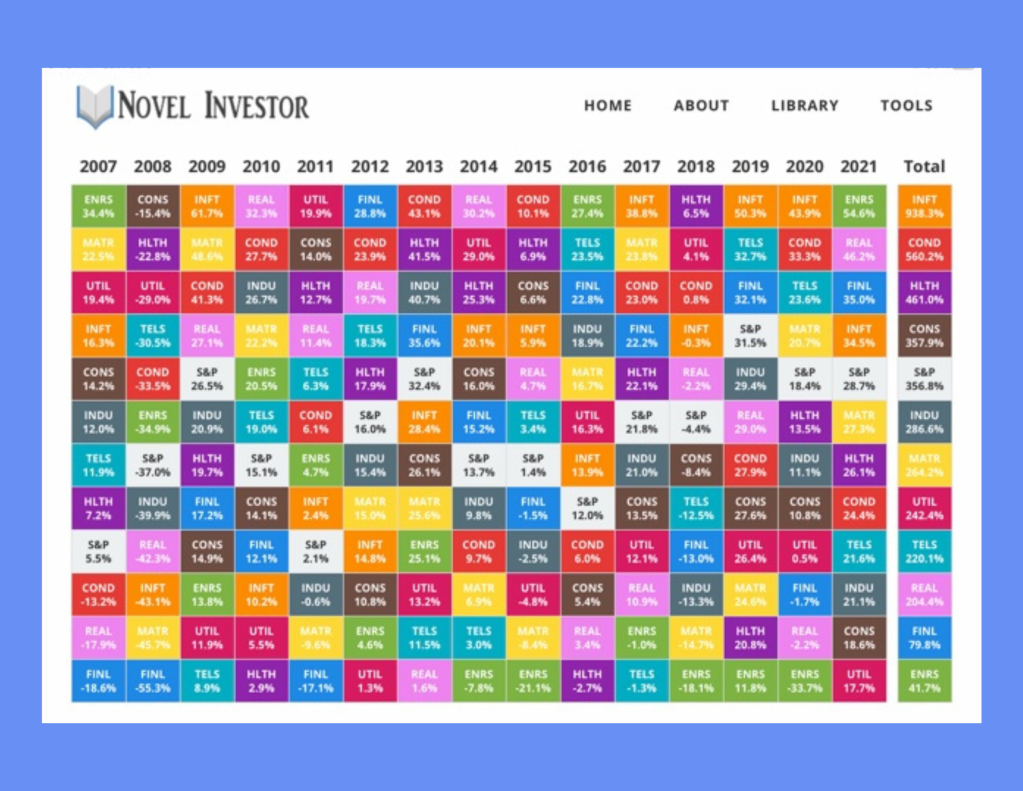
Financial Periodic Table Some of my more interesting observations from these are:
- In the long run, there are no ‘best sectors’ for the investor. They all take turns at or near the top. This is why diversification across the economy is important.
- Sectors for the most part, over the very long run, have annualized returns somewhere between 6-9% give or take. As you can see below, the last decade has seen a strong and long bull run, not entirely normal with exaggerated positive returns. Certain sectors like technology have overperformed. It was in the number one position in 2017, 2019, and 2020 and although it placed fourth in 2021 it was a very strong return.
- Reversion to the mean requires that technology place much lower in the future in order to average down its return to historical levels. Maybe it’s different this time? “When will it happen?” is the better question. It’s the main reason I am a little underweight in tech with more defensive positions.
Looking Forward
I continue to believe that there will be lots of volatility in 2022 (and maybe opportunity). There are so many moving parts that it’s difficult to say where it will all end up. Certainly, a reversion to normal returns as stated above will make its way to the market one day, but likely not this year. Likely some rotations from strong sectors to weaker sectors will continue to occur. There is so much money in the system that it’s hard to believe that the market could go negative for any real length of time.
For the Record
I continue to be underweight in technology and utilities and overweight in financials and energy. The other sectors are normally weighted, including communications, which was underweight till this month. I am also underweight in US positions and overweight in Canadian and international positions. I sense that at some point energy will max out with the price of oil, at which time it will be time to underweight it.
Happy investing.
Marc’s Monthly Moves
Buy Sell Verizon (VZ), more
Netflix (NFLX)
Alibaba (BABA)Activision Blizzard (ATVI), half Marc’s Portfolio YTD Performance
- Portfolio return -1.1% (Including currency gains)
- Portfolio return -2.1% (without currency gains)
- S&P 500 return -5.57%
The portfolio overperformed the S&P 500 by 3.5%.
-
Marc’s 2021 Portfolio Returns
Originally published January 2022
Not unlike most of the 2021 world Covid dumpster fire, the investment world has also been really volatile, which has been both good and bad. How can it be both? Well, my 19% portfolio return is nothing to sneeze at until you factor in that the SP500 USA index returned about 28% in total. It was a weird year where about 5 big companies (Apple, Tesla, Facebook, Google, and Microsoft) pushed the market up.
This situation will play a huge role in the underperformance of active portfolio managers and small investors. Said another way, unless you were lucky and concentrated on those exact stocks or were heavily invested in one particular winning sector you likely underperformed. But to be honest, it’s sort of like that every year, just worse this year. The reality is that if my portfolio had been more like the index in composition, I would be a lot closer in performance.
Guess what? If you were invested in market index ETFs, Congratulations! With little effort, you had a fantastic year. Holding any one or combination of market index ETFs provided you with the following returns: TSX 24%, SP500 28%, or a world index like the URTH ETF at 22%. The argument for market ETFs continues to play out in favour of this style of investing.
Marc’s Portfolio 2021 Final Returns
- Portfolio return 18.3% (Including currency losses/gains)
- Portfolio return 19% (without currency losses/gains)
- SP 500 return 26.89% plus 1% est. dividends = 28%
- Tsx return 21.74% plus 2.25% est. dividends = 24%
Overall, the portfolio underperformed against the S&P500 by -9%.
2021 S&P500 Return Breakdown by Sector
- Energy 48%
- Real estate 42.5%
- Information tech 33%
- Financials 33%
- Materials 25%
- Health Care 24%
- Consumer Discretionary 24%
- Communications 20.5%
- Industrials 19%
- Consumer stapes 15.5%
- Utilities 14%
Energy is the big winner, but its effect on the index was muted because it’s such a small component. If you had an oversized amount of these (you know who you are) you had a fantastic year.
Real estate is also a small component and its performance was a big surprise due to the expectation that Covid would crush real estate companies. Real estate companies were busy revamping their world due to new Covid space requirements. Oddly, this created lots of work for these companies.
Information Tech had another big year and considering it’s the biggest sector it’s also where the game is won or lost for most investors. It also begs the question… will its high returns continue after such a long run? Will growth stocks, in general, continue to outperform? No one knows for sure in the short run but they are getting really expensive.
For Berkshire fans, BRK.B finally outperformed the sp500 by about 1%. This is great news considering it has been underperforming for almost a decade and was a recent addition to my portfolio.
My New Strategy
Is there a new strategy moving forwards? Maybe, sort of. I recognize that there are lots of new risks in the market and moving to a more defensive strategy was likely overdone for 2021. A 9% underperformance is just too expensive a price to guard against tail risks like a crash that may take years to materialize. The new strategy is rather boring, it likely means the same strategy as before except I will bring my sector allocations a little closer to the index. Be more like the Index! At the same time, I need to pay more attention to diversification as well as be more strategic with individual stock picks. I will make adjustments going forwards… slowly but surely.
How did you do in 2021? Did anyone beat the market?
Happy investing.
-
Know Your Portfolio’s Weaknesses
Originally published December 13, 2021
Market Observations
What a wild month it has been. The portfolio started to catch up in all the downward volatility only to fall even further behind when the market ran back up. Some of you also noticed that when the market went up, it did not bring everyone along for the ride. It happens often enough when certain big components of the index drive the market up single-handedly, which is fine if you have a market ETF, but if you don’t own those particular stocks you are out of luck for your own performance.
The Canadian and international indexes have lagged against the US indexes. The tech sector was once again the number one performer. It’s particularly frustrating for anyone like me who has decided to be defensive. The cost of being different is mounting and there is an argument for adjusting back, at least a little bit, to a more market-like portfolio. It is what it is. For the moment I am moving slowly towards a more index-like portfolio. I will likely continue to make a few moves in the new year. Nothing dramatic, but definitely some adjustments.
Risks of Growth Stocks
Some of you got caught in the Docusign (DOCU) fall last week. Docusign, which is the company that leads the pack in providing software solutions for electronic signatures, provided a slightly lowered guidance to their future expectation of revenue. The stock then dropped 40% in one day… ouch. I bring this up to point out that the small investor needs to keep an eye out for positions they hold that may have become risky over time, or maybe were always risky but they did not realize it. Often a position will go up in value very quickly in an exuberant market, beyond its intrinsic value. This is ultimately what everyone wants, but if the story of the company changes, so does the value… quickly.
Don’t get me wrong, you need some exposure to growth stocks that are based on hopes and dreams, but not too much. These companies are easily identified, since the usual way of measuring them is more difficult as they often have no earnings or their pe ratios are over 35, sometimes in the 100s. How do you value something that makes no earnings? Well, you end up trying to value them in other ways like revenue growth, price per sale, or free cash flow. These are not straightforward approaches to value a stock so there is much more room to get it all wrong. Amazon and tesla are good examples, historically very little earnings were made but huge growth created large companies. What are they worth? They make no money. They just grow, so they are worth something for sure, so the market supply and demand will ultimately determine their value, and it can be volatile.
Review Your Portfolio for Weaknesses
So what am I trying to say? A portfolio should be reviewed for weaknesses from time to time. Warren Buffet’s rule number one is to not lose money, followed by rule number two which is to go back to rule number one! It comes down to avoiding big mistakes. Is your portfolio solid? Or are you holding too many Tesla or Docusign companies? There are other ways to murder money as well. These include holding too few sectors (not being diversified), holding too much cash, holding too much fixed income, like bonds, or too many income stocks like REITs that are interest rate sensitive. As I said earlier, I have no issue with holding a stock like DOCU or Tesla, but it has to be part of the more speculative portion of the portfolio, which should comprise no more than 5% for most people. If things go bad, it’s not the end of the world. I know someone whose wealth is almost entirely based on Bitcoin. He has been lucky, but luck can run out quickly.
My Portfolio Weakness
Where is my weakness? I believe I have become too defensive which has caused some serious underperformance. I simply do not think at this point that being so defensive is going to be worth it in the long run. I think the strategy to be defensive is sound, but I think I perhaps took it too far without realizing it. At the same time, I do not want to swing too far the other way and expose myself to the risks that I have been trying to avoid in the first place.
In the future, I will likely continue to increase my tech and coms positions, so stay tuned.
Calculate Your Annual Performance
Finally do not forget that it’s year-end. Take note of your dec31 portfolio value to determine annual performance this year and to create the starting point for next year. If you don’t do this annually, it’s like driving without gps, or headlights, etc…
Happy investing.
Marc’s Monthly Moves
I have sold BABA as a tax-selling move. I will likely buy it back in 30 days. I have purchased Google to increase my communication sector, which is underrepresented. Google is a giant monopoly, high quality, and still growing.
Buy Sell Google (GOOG) Alibaba (BABA) Marc’s Portfolio YTD Performance
- Portfolio return 17% (Including currency losses/gains)
- Portfolio return 17% (without currency losses/gains)
- SP 500 return 25.45%
- TSX return 19.83%
The portfolio underperformed against the SP500 by -8.45 points.
-
Should You Get Professional Wealth Management?
Originally published November 17, 2021
I decided this would be a good post to share my thoughts about professional wealth management. I often get a lot of questions about this. But first, a bit about my underperforming portfolio.
My Portfolio Continues to Underperform
The portfolio continues to underperform, gyrating back and forth but getting a little worse. After a review of my strategy, it appears that for the most part, I have the big picture correct. I overweighted energy and financials, which both are the number 1 and 2 performers year to date. So why am I still underperforming? The problem does not lie in this part of the strategy, but in the de-risking of my information technology sector component. If you recall I underweighted the tech sector and paired down high flyers like Shopify and Kinaxis, replacing them with unloved positions like Verizon and Intel. It’s a good strategy if you expect the risky information technology sector to crater, however until now, this sector continues to do relatively well. My undersized and unloved version of the sector within my portfolio did much worse as a result. The unfortunate reality is that the information technology sector along with its cousin, the communication sector, represent almost 40% of the SP500 market.
So why does that matter? The market has such a large proportion in the information technology sector that the game is mostly won and lost by getting that one sector right either by weight or by having the right stock picks, of which I have neither. Is my approach safer? Yes, but it comes at a cost.
Am I ok with this? Sort of. There is no way around it. If you want to de-risk, you have to expect to underperform for a while. I identified this possibility early on and it is exactly how it played out. My return is actually good for the amount of risk I have and this is why not all returns are the same, even when they are identical.
The Case for Professional Wealth Management
This part is where I awkwardly try to tie in Wealth Management Fees.
Why I Use a Wealth Manager
Marc why do you pay a wealth manager x% per year and underperform the market? Don’t you usually beat the market with your own hobby portfolio? Great but annoying questions!
As many of you know, the majority of my retirement fund (85%) is managed through TD Wealth. I often get slack from my investor friends for paying an annual management fee to TD. Particularly when the returns in my hobby portfolio almost always exceed my TD Wealth Management returns. Why don’t I just manage the whole thing?
The reason I do this is that TD Wealth provides a slightly less than market like return with a much more solid (read boring) portfolio. The idea here is that the TD portfolio would be more resilient in any market decline. Being retired with no other income, I require a financially sustainable path to my death in 2072. Basically, I have chosen the higher-quality portfolio that TD Wealth provides with a slightly lower return. It’s a trade-off, just like de-risking the hobby portfolio.
It’s a similar approach for those who hold Warren Buffet’s Berkshire Hathaway. Berkshire has underperformed for almost a decade, but when you look deeper, the return for risk is really good. No one will end up having to eat cat food if you are invested in BRK.B. Could Warren, TD Wealth and I all over-perform in the future? Yes, but the market temperament has to change first. Right now, the market values high-growth stocks with a higher risk profile. The day when value-style stocks flourish will come, but it may take a while.
Could I manage a similarly lower-risk portfolio and save the management fee? Yes, I could, but it would be boring, and I would not be as good at it. I would also not manage the entire amount the same way that I manage the hobby portfolio. Once it becomes serious and important to my life, it loses the fun hobby aspect. Would I trade options? No sir, that’s my future that I am messing with. Would I build strategies that overweight sectors as I do now? Hmmm, maybe not as much. Unlike most people, I do not work and cannot make up for mistakes with time and a paycheck. Once in the retirement zone, you certainly have to be more conservative. That’s why I have a hobby portfolio to play with, which is independent of my wealth account.
The other benefits I get from the TD Wealth Management account are:
- tax strategies (I suck at those).
- no dumb mistakes, such as my GME option fiasco, holding too much cash, or emotional buying and selling.
- no monthly portfolio decisions (selling stocks every month to cover my retirement expenses.
- no dividend income forecasting – they do that for me.
- future projection modeling.
Wealth Management is a personal choice. I’m retired and prefer to spend my time doing other, more fun things than managing my retirement account every month.
A few other important things to keep in mind:
- The portfolio management fee is tax deductible for non-registered accounts, so the fee is actually under 1% for me.
- Wealth management is also more affordable the more money you have under management. Fees range from .75 to 2% annually depending on your institution.
- It cost money to be in the market, even if you are doing all the work yourself. There are trade fees, admin fees, ETF fees, mutual fund fees, and tax withholding fees, some of which can exceed 1% annually.
Other Reasons to Consider Professional Wealth Management
If you chronically underperform the market, then Wealth Management is totally worth it. The difference in performance usually makes up for the fees and then some.
Quick note: Wealth managers are just like mechanics, some are good, and many are not. Best to be choosy, as performance will vary.
Alternatives to Wealth Management
Holding a couple of key market ETFs could provide a better return if you’re ok with the associated market risk.
If your return expectations are really low, i.e. you want dependable low-risk returns by having half your portfolio in fixed income and the remainder in dividend stocks, then you simply are paying too much for that low safe return. If your trying to achieve 4% and now you pay a 1.5% management fee, that is expensive! A Wealth Manager, in this case, is barely working and still collecting a fee. You need more performance (and risk) to make it efficient.
Final Thoughts on Wealth Management
In the end, there are many ways to skin a cat, and investing is a personal endeavour that really needs to be done with consideration of your individual needs. I know what works for me, but everyone is different with different risk tolerance, and return expectations. The situation I see too often is small investors who underperform the market by quite a bit with high-risk portfolios but cannot accept the idea of paying a fee for something they already do. So you underperform by 5% but save a 1% management fee. Are you really ahead?
Happy investing.
Marc’s Monthly Moves
If you got this far down, apologies, this got wordy. On a lighter note, my recent picks like Cameco and Krane shares ETF have both taken off with 45% and 25% returns respectively….in just a few short months. As noted above, I have increased my position in Krane shares as there seems to be growing interest in the carbon credit market.
Buy Sell KraneShares Global Carbon Strategy ETF (KRBN), more Marc’s Portfolio YTD Performance
- Portfolio return 18% (Including currency losses/gains)
- Portfolio return 19.5% (without currency losses/gains)
- SP 500 return 25%
- TSX return 25%
The portfolio underperformed against the SP500 by -5.5 points.
-
My Portfolio Update
Originally published September 2021
The Big Picture
The investment world continues to buzz about the market being overvalued and there being an eminent crash or worse, a decade of poor or negative returns. At the same time indexes continue to gain week by week. How can the market be both about to collapse and continue to rise at the same time? If everyone truly believed that the market was going to go bust, everyone would obviously bail, but they have not. The reason for this is complicated, but for the most part, it comes down to the fact that no one really can predict the immediate future. Overall this year’s returns are looking super, though that is not the sentiment on the street. As always, the smart investor stays in the market no matter what, through the good times and the bad times knowing that their time in the market that will eventually provide good returns.
The Small Picture
The hobby portfolio’s performance has emerged from what would seem to be a bad dream. It’s no longer losing ground to my benchmark, the SP500, and in fact, has gained ever so slightly. Hopefully, this trend can continue. I apologize that there was no newsletter in August… me bad and life got busy. I don’t get paid enough to guarantee a newsletter every month, lol.
One New Purchase and One Old
I have added MSOS, a cannabis ETF, to the portfolio. I have been historically anti-cannabis stocks due to the high prices and high volatility. What has changed? Pot stocks are out of favour right now and stock prices keep falling. Could they continue falling? Absolutely but after an almost 50% fall from their previous highs, it seems like a good entry point. The legalization of cannabis in the USA continues to move forward but slower than most had expected. If the trend continues I could forsee the day when Americans can buy pot stocks legally on the main stock exchanges. When the move to list these companies on mainstream exchanges occurs, there will likely be a pent-up demand situation where stocks could get bid up. As a result, I do like the long-term chances going forwards.
On the volatility side of the equation, I have chosen an ETF instead of a single stock position. This will obviously lower the chances for a huge homerun return, but it will also ensure that I don’t end up murdering money with a bad luck pick. This is not a casino after all.
I double downed on Alibaba (baba) the Amazon of China. It’s been out of favour for quite some time and my losses are mounting. Buying something out of favour is difficult because it usually continues to fall and it drags down returns. However, if the investment strategy is solid, then sometime in the future when trends reverse, you get over performance. Buy low sell high… simple but often difficult and generally counterintuitive to achieve. Patience and discipline are hard at work here and are obviously being tested. This purchase averages down my cost basis, which is good if things work out. If the outlook remains bleak, then in hindsight the purchase will look like I threw perfectly good money after bad money. In the end, they can’t be all winners, but as long as your winners win more than your losers lose, then it’s all good.
I sold off my small cap ETF VTWO. I still like it, and it has provided good returns – 15% over 6 months. However, I needed to pay for new purchases with something…always a compromise!!
My new uranium play Cameco (CCJ) is up 16% in six weeks, not bad, but it’s really just good luck and luck can always run out. It could have easily fallen just as much as is often the case for out-of-favour stocks.
My Morning Brew Recommendation
Some of you already have “Morning Brew”, a daily financial newsletter. If you can get past the obvious ads, it does provide a daily pulse of what’s going on and some entertainment as well. It’s free, so no cost to you. You can find it here.
Happy investing.
Marc’s Monthly Moves
Buy Sell MSOS Cannabis ETF
Alibaba (BABA), moreVanguard Russell 2000 Index Fund ETF (VTWO) Marc’s Portfolio YTD Performance
- Portfolio return 15% (Including currency losses/gains)
- Portfolio return 16.6% (without currency losses/gains)
- SP 500 return 20.75%
- TSX return 19.43%
The portfolio underperformed the SP500 by -4.15 points.
Home
-
The Financial Periodic Table
Originally published February 6, 2022
Portfolio Update
It’s been another good month for the portfolio versus my benchmark, however, I am still slightly negative for the year. There has been a lot of volatility in the markets and most of it is playing in my favour as it relates to my more defensive positioning. My over-weighted energy and financial sectors sit at number 1 and number 2 spots for monthly performance while communications and technology sit at second to last and third to last. It’s difficult to say if this trend will continue.
I sold half of my Activision Blizzard position as it had a one-day gain of 25% after Microsoft announced it was buying it. It’s a complex buy because of the potential for anti-competitive laws that could simply not allow it. So the stock remains about 10% below Microsoft’s purchase price. By selling half I guarantee a large chunk of the sale premium and if the sale goes through I get an additional premium. This position is up in total for about 67%… not too bad for a recent pick.
I bought Netflix after its 25% fall due to a lackluster earnings report. Bill Ackman who is a renowned stock market player bought 1 billion dollars of the stock shortly after the report. Bill is right 80% of the time. My stake along with Bill’s stake will provide him with some ability to influence the company to make more money. That is the theory in any case. He still has not returned my calls.
I re-bought Alibaba and then some. There are few companies that on paper look as good as Alibaba. It’s been in the dog house for a while and the stock price reflects that. I am not sure how you can lose on this one in the long run. Time will tell.
I bought more Verizon. This brings my communications sector up to 10% which is in line with the market weight. Nothing fancy here, good dividend, and Warren Buffet also owns it.
About the Financial Periodic Table
I often refer to the financial periodic table (below). No, it’s not exactly science, but it helps investors understand that stocks are based on supply and demand. They go up and down like fashion, something is hot something is not. Sometimes leaders are based on earnings or expected earnings and sometimes ithey are based on human emotions like fear and greed. Either way, it gives you the big picture of how sectors change leadership over time.
Financial Periodic Table Some of my more interesting observations from these are:
- In the long run, there are no ‘best sectors’ for the investor. They all take turns at or near the top. This is why diversification across the economy is important.
- Sectors for the most part, over the very long run, have annualized returns somewhere between 6-9% give or take. As you can see below, the last decade has seen a strong and long bull run, not entirely normal with exaggerated positive returns. Certain sectors like technology have overperformed. It was in the number one position in 2017, 2019, and 2020 and although it placed fourth in 2021 it was a very strong return.
- Reversion to the mean requires that technology place much lower in the future in order to average down its return to historical levels. Maybe it’s different this time? “When will it happen?” is the better question. It’s the main reason I am a little underweight in tech with more defensive positions.
Looking Forward
I continue to believe that there will be lots of volatility in 2022 (and maybe opportunity). There are so many moving parts that it’s difficult to say where it will all end up. Certainly, a reversion to normal returns as stated above will make its way to the market one day, but likely not this year. Likely some rotations from strong sectors to weaker sectors will continue to occur. There is so much money in the system that it’s hard to believe that the market could go negative for any real length of time.
For the Record
I continue to be underweight in technology and utilities and overweight in financials and energy. The other sectors are normally weighted, including communications, which was underweight till this month. I am also underweight in US positions and overweight in Canadian and international positions. I sense that at some point energy will max out with the price of oil, at which time it will be time to underweight it.
Happy investing.
Marc’s Monthly Moves
Buy Sell Verizon (VZ), more
Netflix (NFLX)
Alibaba (BABA)Activision Blizzard (ATVI), half Marc’s Portfolio YTD Performance
- Portfolio return -1.1% (Including currency gains)
- Portfolio return -2.1% (without currency gains)
- S&P 500 return -5.57%
The portfolio overperformed the S&P 500 by 3.5%.

