Home

  • Why Does the Market Have Bad Breadth? 

    August 2023 Newsletter

    In a few short months the portfolio has gone from a small beat to lagging by 2.4% – see performance stats further down. Don’t get me wrong, it’s still a nice return, but its concerning as the situation worsened at one point during the month, lagging by 3.5%. I usually start looking at why performance is lagging once there is a 2% difference between my portfolio and the market.  Sometimes something gets screwy with the portfolio, other times it can be bad luck (or a combination), and sometimes the market changes.  In this case, it’s my opinion that the market is changing and it’s likely normal. 

    The market is always evolving based on millions of buyers and sellers creating the “efficient market hypothesis” which basically means that it reflects all known information and provides the right market value at any point in time.  I do not entirely agree with the hypothesis because to me, it’s much more complex than that.  The market is emotional because buyers and sellers are emotional, so when you add that layer to the hypothesis, the market becomes much harder to value and predict, and can even behave irrationally at times. 

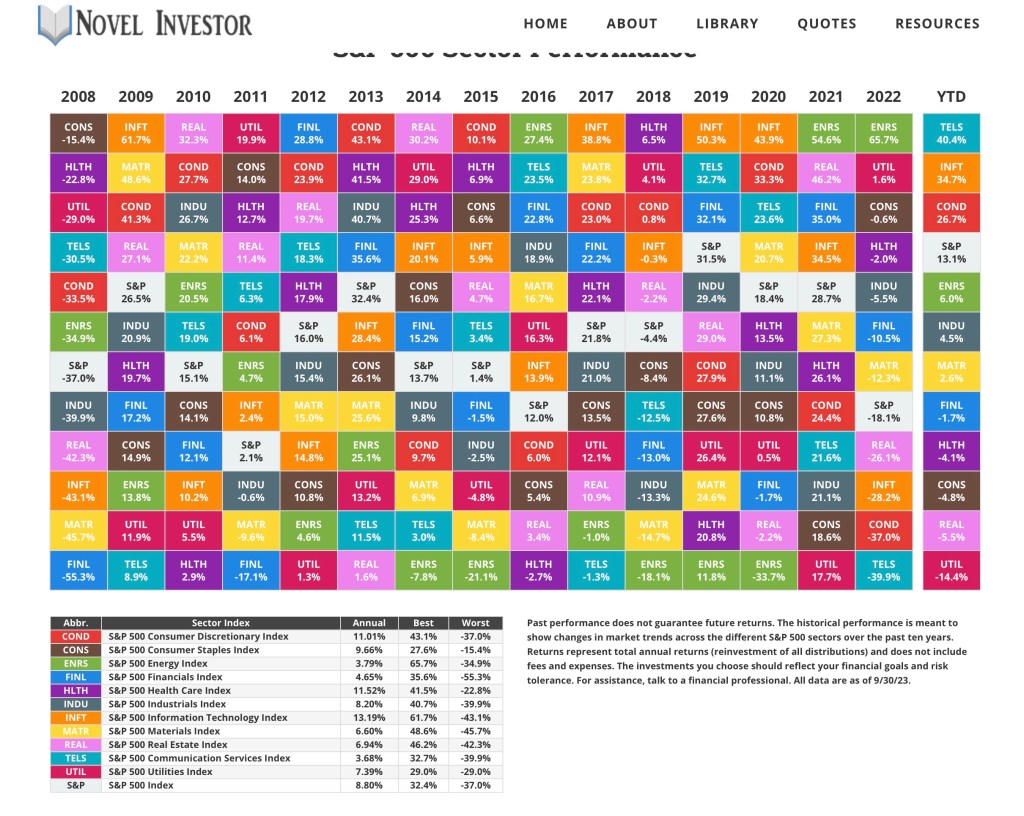
    That being said, the market lately has been oddly bidding up just a few stocks like Apple, Microsoft and five others – see the list below. The effect is that market index returns have become a reflection of just those few, mainly because of their oversized influence on the market.  This situation is not unusual and has often occurred in the past as part of new bull markets.  The reason for this is difficult to pinpoint, but after a bad period like 2022, investors likely want to stick with what worked, in other words big American tech. 

    This creates bad market breadth, not halitosis as your brain likely read first.  In simpler terms, breadth is how much of the market is participating in any up or downturn.  The issue is made worse because the market index is weighted.  The bigger the company (measured in capitalization) the more it influences the average and skews results in their favour.  7 big winners and 493 losers can still be a positive market.  If the market is up 10% then it would be nice that no matter what you hold in your portfolio, you could still participate in the rise.  But bad market breadth can leave you behind. This is especially true when market moves are up big or down big.

    The Big 7

    Please find below the weights of the big 7 as a percentage of the total sp500.  Example: Apple represents 7.6% of the total value of the SP500.

    • Apple 7.6% 
    • Microsoft 6.5%
    • Google 3.8%
    • Amazon 3.1%
    • Nividia 3.1%
    • Tesla 1.88%
    • Meta 1.8%

    As you can see, the 7 biggest stocks in the SP500 control almost 30% of the index’s return.  If all 500 stocks were equal, then each would contribute exactly 1/500 of weight, or 1/5th of a percent. So the top 7 are disproportionately influencing the index’s return.

    This also means that no matter what you pick for stocks, from a probability perspective, you will likely underperform the market without some of the top 7.  As per last month’s newsletter, you can see the results of bad market breadth by looking back at the RSP ETF, which tracks the SP500 without the traditional weights.  This effectively shows us how the average market is doing, which in this case is heavily underperforming at 4.27% (vs the SP 500 return of 13.8%). 

    So does that mean stock picking does not work?  Maybe we should simply buy market index ETFs? There is an argument for that.  It’s certainly harder in this situation if you are looking at today’s probability of selecting winners for your portfolio. On the other hand, macro investors, those who try and choose stocks based on interest rates, sector weights, economic cycles etc., historically tend not to over perform either. In recent years, momentum strategies (following the heard) seem to be one of the few strategies that have been over performing. Until the heard eventually runs off a cliff… no strategy works forever.

    Traditionally higher over performance (also higher under performance) is achieved in concentrated portfolios (smaller number of stocks), like 6-8 as an example.  With a bad breadth situation, the odds are much worse.  Your stock picks might be awesome, but if they do not include some of the top 7, your likely underperforming big time.  

    In my case, with 40 stocks in my portfolio, I have more chance of holding a winner. In fact, I hold 4 out of the 7. I am much more like the market but at the same time, I have lots of under performers diluting those big returns. If I only held a portfolio of 8 stocks and 4 of 8 were big winners, I could become famous, or rich, or both! Again, concentration creates compromise – you can become a bigger winner or a bigger loser.  With a higher number of stocks, your returns will likely be closer to the market return, so it will be more difficult to win big but also harder to lose big.

    Should I Change Strategy?

    That is a really good question.  No one knows for sure what the market will do next.  We only have history to provide some insight.  If we are in a new bull market that will last 5-6 years, then we can expect the market to rotate in a fuller breadth situation and the big players will slow down and the rest of the market will catch up.  But how long will this bad breadth keep going? Months? A year? 2 years?  No one knows for sure.  

    What if the new bull market stumbles and we go into a recession?  Returns will go negative, led by the big 7.  Money for Marc is about getting rich slowly and not about taking huge risks.  I like to play the odds and these determine my strategies. I really prefer to have a bit of everything in my portfolio so as to never lose big, which also means never win big either.  Market like returns are good enough for me. It’s a relative game after all.

    Am I Really Going To Do Nothing?

    Contrary to most financial vloggers, advisors, etc., I would advocate the “do nothing approach” at this time, which more often than not is the right answer.  Even if it means under performing for a while.  I play the long game after all.  The knee jerk reaction is to start selling off losers and buying more of the big 7.  This unfortunately caries higher risk as you are potentially buying high and selling low. You could argue that these new positions may be expensive relative to the market. The benefit however is that if the trend continues, you will be pulled up along with the market.  This situation is difficult because no one likes falling behind, and as humans, we tend to want to react and do something about it. Any changes need to be made carefully when the market starts getting away from you.  Loading up on the big winners will increase risk for sure. Will it be worth it? Maybe, maybe not.

    Looking Forward

    I am still bullish on a strong year return. I will likely make some small changes in the portfolio to rebalance some sectors and adjust my country mix.  I will likely invest in one new position, maybe Japanese.

    I expect that the market will have a much fuller breadth and that market leaders will eventually stall.  

    I expect an eventual rotation into more unloved areas like small to mid-caps, value stocks, foreign stocks, and actually most sectors (that are not technology, communications, or consumer discretion). There are a lot of loser areas that will one day become winners.

    Marc’s Monthly Moves

    • Sell ATVI (Activision Blizzard), for 91$ for a return of +66%.  I bought this before Warren Buffett did and sold it at a better price than he did… nice to out invest the best (obviously some luck was involved)!  This company is being bought out by Microsoft for 95$. There is only 4$ of uncertainty left of whether the sale will go through or not, so its a good time to sell and super return.

    Marc’s Portfolio YTD Performance

    • Portfolio return:11.4 % (including currency losses)
    • Portfolio return: 11.4% (without currency losses)
    • S&P 500 return: 13.8%
    • RSP ETF S&P equal weight 4.27%
    • TSX: 2.24%

    The portfolio has under performed the S&P 500 by 2.4 percentage points.

  • Another Way to Beat the Market?

    June 2023 Newsletter

    In my quest to beat the market, I am always searching for new ideas that could give me an investing edge.  You can find these approaches anywhere such as in print, podcasts, Youtube and books.  I recently read “100 Baggers: Stocks that Return 100-to-1 and How to Find Them”, by Christopher W. Mayer.  It’s not entirely a new idea, as it’s basically a modern reinterpretation of an older work by Thomas Phelps.  Effectively it has the same messages but uses modern data and more recent company case studies.

    The book has a few interesting themes that I believe are useful for the small investor.  Finding and owning a 100 bagger is difficult for a number of reasons but not impossible.  You just have to look around at all the big names like McDonalds, Apple, Amazon, Microsoft and Monster Inc. as examples. They were all small companies at one time and if you bought them early, they eventually all became 100 baggers or more.  The book demonstrates what to look for based on the commonalities of 100 baggers.  The recipe for 100 baggers is quite simple in practice, but very difficult to achieve at the portfolio level.  So let’s set out the recipe as outlined in the book:

    Small: 

    You simply cannot get a 100 bagger out of Apple anymore – it’s just too big.  Small companies are where you are most likely to find the 100 baggers.  So how small?  Anything with a valuation of under $1 Billion is where to look.  Besides being small they generally need to be well run, high quality, with some kind of moat to ensure a longterm competitive advantage.

    Fast growing:

    You cannot achieve 100 to 1 without growing year after year at a fast pace; we’re talking 25% growth per year or more.  Also there should be no dividends; the earnings must all be plowed back into the company to keep compounding the growth.  Growth is a little funny, growth in earnings, sales, free cash flow are all fair game when evaluating a potential 100 bagger.

    Inexpensive valuation:

    If you pay too much for growth, it’s not going to work.  In fact, the author says the key to a 100 bagger is to combine high annual growth with an increase in what the market is willing to pay for that growth in the future.  In other words, low price per earnings is necessary at purchase, followed by higher price per earnings in the future. It’s these two factors that mathematically combine to create the potential for a 100 bagger.

    Skin in the Game:

    The author notes that a large proportion of 100 baggers have an owner-operator with a significant ownership stake.  This is not unusual and has been covered in other books like “One up on Wall Street” by Peter Lynch.  In fact, there are funds that invest in only owner-operator companies and for the most part, they tend to outperform the market.

    Time:

    So the last piece that ties the approach all together is time.  It requires a buy and hold approach that is quite long – we’re talking decades.  Within the book there is much discussion about the “coffee can” approach to investing: buy a good company, sock it away, and forget about it. It’s similar to the way people saved money in the olden days, before electricity and flip phones.  The idea was that when you made a dollar, you hid it in an old coffee can in the kitchen, and did that for years till one day you could retire.  A non-anecdotal example is the Voya Corporate Leaders Trust. It’s a fund established in 1935 that invested in the biggest companies of the time.  As part of its design, the fund could not purchase or sell any stock after its inception.  This is the true meaning of buy and hold.  The fund has beat the SP500 since 1935!  It still exists! Interestingly, some of the companies within the trust died over time, but others kept growing or changed by way of mergers, splits and other deals. The point of this chapter is that ‘Buy and Hold’ as a concept is very powerful, because it removes the human need to interfere due to fear or greed.

    What do I think of the book?

    There are a few good recommendations, like the buy and hold approach as well as the owner-operator advantage.  Where it falls short, and the book does allude to this problem, is that few investors have the ability to do a 20-year buy and hold strategy.  Even if things play out in your favour and now you have tripled your money on a small risky stock, there is an argument to sell off some and lock in profits.  It’s a nice problem to have, do not get me wrong, but even from a portfolio management perspective, you cannot as a small investor tolerate a position that represents 25% or more of your portfolio.  It’s just not prudent to have most of your wealth caught up in a speculative position.  In addition, small companies are generally more volatile, even big companies like Amazon went through huge up and down cycles in the beginning, which would drive any investor to lose sleep or go mad.  Surely emotion would end up prevailing, resulting in a sell after a big run up in price or a big fall.  The reality is that its really hard to follow a potential 100 bagger to a hundred.

    Probability is another problem as it relates to small companies.  Lots of small companies run out of money and die for all kinds of reasons. About 80% of small companies don’t have positive earnings and are less able to deal with adversity than a giant well capitalized company.  Picking the right company, even after you know all this, is difficult and against the odds.  In other words, any stock picks resulting from copying this approach should end up in the speculative area of your portfolio.  My speculative positions only comprise of around 2-3% of my total portfolio. It would make no sense to try and invest all my savings in an attempt to land 100 baggers, because the likeliness of striking out is relatively high.  That being said, if you happen to get just one right, you may have a life changing situation…if you can manage to hold on to it to the end.

    What is the small investor to do?

    I always find something of value in reading books and this one is no exception.  It has made me think that I should be more serious about my speculative positions.  Generally, I just react to events in the market.  It’s more of an entertainment activity than a strategy.  It would be interesting to buy a few small companies and see what happens, understanding that some could end up dead.  As I have always said, there is room in a portfolio for some speculative positions.

    Portfolio Update

    The portfolio YTD is up 15%. It’s a good return but it is now lagging the SP500 benchmark by (2.34%) after having been ahead for a while.  It’s a weird market with only a handful of sectors doing well.  These are Information Technology, Communications and Consumer discretionary at 40%, 35% and 33% respectively year to date performance.  The other 8 sectors are seriously underperforming the SP 500 17.34% YTD average return.  Worse for small investors is that even within the winning sectors, there are a small number of big players that account for all the gains.  Chances are good that most investors are lagging this year.  You need to be lucky to be in the right sectors and the right companies.  

    A good indicator to judge the market is to look at the Invesco equal weight ETF, symbol RSP.  This ETF is basically the SP500 index without the weights, so that every company is equal to Apple, or Amazon.  The YTD performance on RSP is 7.65% which is about 10 points less than the weighted market index.  It demonstrates how your average companies are doing and not just the biggest ones.  Luckily my portfolio happens to have a few of the big winners like Amazon, Apple, Google, and Netflix .  I am also overweight in communication sector stocks (which is part of my Bear strategy).  Nevertheless I am slightly lagging.  It’s a good return, but behind the market just the same.  Another reason for underperformance, which I have not verified yet, is that that the Canadian market is really lagging at 4.5% YTD.  My portfolio, although mostly American, does have a few Canadian positions, which is likely not helping.  If your portfolio is all Canadian, you’re likely having a bad year.

    Looking Forward

    I still think it’s a weird market and that there are a lot of reasons why the year may finish up well, as I alluded to at the beginning of the year.  We are already above an average return which sounded like a crazy forecast back in January.  Could we push 20% by end of year?  Why not? That is an average bull market return.  You must remember that the long term market average of 10% is comprised of big positive bull years and big negative bear years.  It’s rare that we actually see the average.

    Marc’s Monthly Moves

    • No buys or sells this month.

    Marc’s Portfolio YTD Performance

    • Portfolio return:12.5 % (including currency losses)
    • Portfolio return: 15% (without currency losses)
    • S&P 500 return: 17.34%
    • TSX: 4.5%

    The portfolio under performed the S&P 500 by 2.34 percentage points.

  • How I Lost My Entire Investment!

    May 2023 Newsletter

    If you read my last newsletter, you will know that I made a speculative stock bet with First Republic Bank (FRC).  Banks are normally not speculative, they are usually pretty safe, but not in this case.  As mentioned before, banks exist almost solely based on the confidence that if you deposit your money with them, you can withdraw any or all of it at anytime. The problem is that if everyone asks for all of their money back at the same time (classic bank run), well, there is not enough money to go around.  You see, our fractional reserve monetary system allows banks to lend out most of your deposit money to someone else.  This is how most banks make money. It only keeps a fraction of your deposit on hand for day-to-day cash withdrawals.  It does that with all of its clients, knowing that by average, most people only need a small amount of their funds in cash at a given time.   

    So what was the problem at FRC?  A bank run is a confidence problem. It can be based on something real or not, it does not matter.  In this case, FRC’s bonds fell in value with rising interest rates (like most banks) and this was perceived as bringing the bank to near collapse.  The reality is that bank assets change in value all the time.  In addition, FRC’s model catered to wealthy clients who by average had assets above the 250k federally insured amount.  Meaning that if these clients smelled weakness (and they did), they were more likely as a group to move those funds somewhere else.  If it were not for the run on deposits, FRC would not have had a problem.  This was a perfectly good bank that for right or wrong reasons, lost the confidence of its clients.  The story ends by the Federal Deposit Insurance Corporation (FDIC), also known as the Government, seizing FRC’s assets and selling them to JP MORGAN, leaving FRC stock holders out of luck.  This was a total investment loss.

    Speculation 101

    Ok, I know some of you will point out that there is no clear understanding of what a  speculative position is and that it’s kind of subjective.  This is true. There is allot of grey area here and it also depends on an individual’s ability to accept risk.  That being said, I can provide examples of what I feel is speculative.  Note the word “feel” in that last sentence.  In my opinion, speculative positions, no matter what form they may take, have an inherent danger of losing all or most of your money.  These may include: 

    • very small companies;
    • companies that lose money year after year;
    • leveraged companies that only survive with borrowed money;
    • some cyclical companies, like small gold miners; 
    • small pharmaceuticals with only one product or one product still in development;
    • technology innovation companies that may have a new product, or one day expect to, but may not;
    • most Initial Public Offerings (IPOs); 
    • resource explorers;  
    • commodities, like metals, sugar, etc.;
    • the use of option contracts and future contracts;
    • the list goes on.  

    You can see a few commonalities in the list above… small, makes no money, only one product, based on promises, etc. Everything has to be perfect in order to justify the values, but only a few will actually become successful. 

    So was speculating on FRC dumb?

    The answer to this question in hindsight is yes, but there is more to it than that.  There is room for speculation in investing as long as you keep some basic rules to protect yourself: Never bet the farm on a speculative position; never borrow money to make a speculative bet; and make sure you understand the risk when going in.  Speculative bets tend to be more often losers compared to investment grade stocks, so the odds are against you at the outset.  So why speculate?  Well, you have to look at it as a probability game.  FRC’s bank run was going to end in one of two ways: it survives and everything goes back to normal, or it dies. No one was sure what was going to happen as the situation unfolded, so I figured I had a 50/50 chance either way.  But here is the thing, if I was wrong and FRC dies, I lose 100% of my money, on the other hand if FRC survived, I could triple my money.  In game theory, you would want that bet and play all day and all night, because you win more money than lose in the long run.  Think of it as flipping a coin, heads you lose a dollar, tails you win 3 dollars, it’s the same thing.

    The problem in these situations is that maybe it was not a 50/50 probability that FRC survived, maybe it was less.  Since no one knows for sure, you have to make a call on that yourself.  I knew that banks don’t often go under, I knew that FRC was a good bank, and I knew that other banks and the government did not want it to fail.  A pretty good argument for a 50/50 bet.  In the end I lost and that is the way the cookie crumbles, you win some and you lose some. Let’s not get emotional about it.

    When Things go Right

    Here is an example of a speculative bet that worked out well for me. In 2012 I started to like Apple due to their new higher quality products, great design and innovation, etc. At that time, Apple was out of favour and the argument was that as a small player, it could not compete against Microsoft and other similar companies. I bought 3,000$ in one apple option. This leveraged bet worked against me at first as the stock continued to fall and my 3000$ position became 1800$.  Then things turned around, and within 4 months, my position grew to 22,000$.  I exited the position with 7 times my initial return (a seven bagger).  But that is not all, I then bought a brand new IPad, and took a full position in Apple by buying the stock.  Over the next ten years that position continued to compound for a total of a 42 bagger.  So the moral of the story is that speculative positions, if done right, can pay well.  I keep speculative bets as a very small portion of my portfolio, maybe 1-3%, because they are generally losers. Another example is Bitcoin. Had I speculated on Bitcoin early on, I could have made lots of money with a very small bet.  Another speculative bet I have ongoing is in (KRBN) carbon credits, which is just as weird as Bitcoin. Could it end up being a 5 bagger or more?  Maybe?  Who knows.  Do you have a speculative position? Let me know in the comments.

    What Does a Total Loss Mean to the Portfolio?

    As a result of having a 1-3% maximum speculation position, a total loss is not the end of the world.  The position fell apart before I could even consider buying more shares so in the end, the FRC position did not even register a 1% weight.  In fact, I have already made up for this loss through the gains in other positions. My investment rules saved the day. Even with FRC being a total loss, the portfolio has recorded a small gain versus the SP500 year to date return.  

    Looking Forwards

    Markets are hovering around the long term annual average return of 7-10%.  As some of you know, average returns are rare because most of the time markets are up much higher or down much lower. So I predict that the year will end much higher than average, but no one knows for sure. Short-term calls on the year are usually very difficult to predict.  I nevertheless remain bullish, understanding that there will continue to be lots of volatility and nuttiness out there.

    Marc’s Monthly Moves

    • No buys or sells this month.

    Marc’s Portfolio YTD Performance

    My portfolio page is LIVE! I will continue to update it monthly. It contains a full list of my positions and the performance information that I’ve included below.

    • Portfolio return: 7.3% (including currency losses)
    • Portfolio return: 8.6% (without currency losses)
    • S&P 500 return: 7.73%
    • TSX: 5.97%

    The portfolio over performed the S&P 500 by .87 percentage points.

  • Is Frugality a Super Power?

    I did not retire in my late 40s simply by making loads of money or by being a whizz at investing, contrary to what most people think.  In the beginning like most, I kind of sucked at investing and my returns were all over the place.  Also like most, I didn’t make a lot of money at the beginning of my career; it took years to build up my salary and eventually became above average as I entered management level.  Even so, were talking a public service government job, decent pay, but no jets or Ferraris… a normal income. 

    The biggest contributor to my early retirement was frugality – always being careful with money.  Don’t get me wrong, maximizing your salary and investment income is necessary, as you need something to work with after all.  But managing money ties it all together.  It’s actually very basic, yet so difficult to achieve for most.  You simply need to spend less than you make, invest the difference wisely, get the snowball rolling and let time take care of the rest.  That is the secret sauce and its available to most everyone. 

    So why is it so difficult to implement a basic money management plan?  There are so many reasons the odds are stacked against you.  Let’s just touch on a few obvious ones: Money management is not taught in school, which is kind of odd right?  You get out of school being able to solve a 3 sided triangle but know nothing about investing.  The next problem is that you are bombarded with hundreds of ads a day trying to make you buy something you do not need.  Add to this, most everyone around you drank the Kool Aid and now have shiny new things. The pressure is everywhere and its super difficult to resist all temptations. I bought a 20-year old corvette in my 20s, which was really fun, but financially stupid.  No one is immune to consumerism, its always around us, but it needs to be managed.  Let’s face it, without consumerism, life would be boring, we would live in hovels wearing old potato bags and shoes made of old tires.  Not quite a life for most, even me.  There has to be some acceptable balance where you can still buy fun things, do fun things, but yet still retire early enough to enjoy other fun things.  

    So is frugality a super power?  Not really.  The super power is more in the attitude necessary to truly make frugality effective.  The “I do not care what others think” is really what can liberate you from society’s grip.  The kind of car you drive, the clothes you wear, the house you live in, etc. I am pretty sure people thought I was weird as most everything I did was different than everyone else.  For every purchase, I had an automatic check of: do I really need it?; can I buy it used; can I make it? To this day, even though I am retired, I still follow these rules.  A simple example that demonstrates this attitude  recently came up while I was traveling through Mexico. It was the use of helmets while rock climbing.  My girlfriend just laughs as everyone else has these fancy specific rock climbing helmets while I wear my cycling helmet.  It’s a helmet, right?  So I do not need another.  I apparently look kind of funny… but I do not care. Super Power? Maybe…

    The Small, the Big and the Stupid

    There are a lot of resources about how to be frugal and this article is not really about that.  What I am trying to focus on here is the concept and the power of harnessing frugality and the attitude that you need to make it work.  To do it in a big way, you need to be good with people thinking you are a weirdo.  Winning this game is about staying on top of small potentially reoccurring expenses like lattes or cable tv and big items like cars, boats, and homes.  Many of these purchases are unnecessary,  but masked as life necessities (do your really need a 3000 sqft home… some actually do… most don’t).  Avoiding stupid mistakes on these big financial decisions have big benefits to your future because of the time value of money.  Every dollar saved early in life can compound and snow ball into huge sums.

    Let’s start with the small things… Eating out!  For the most part, I was very good at bringing my lunch to work and mostly avoided buying junk food at the cafeteria.  I remember several occasions over the years where coworkers would question why I did not buy a coffee or snack.  I would normally start talking about compound interest etc… and there you go, I am the weirdo.  There was a year where things got really busy at work and I actually started grabbing a meal every day at the cafeteria.  I thought it was great and now could see how cool this eat at work culture was.  I was making more money and my new work lifestyle reflected it.  At the end of the year I tallied up what eating a quick lunch cost…WTF, 4000$.  OMG I could not believe how this could be so much, and to make matters worse, that did not include eating out on weekends.  I also gained over 25 lbs.  I put a stop to all that, and became a weirdo again.   

    The next example is about the big things like cars. I really like cars, especially sports cars, but I know that cars are an expensive depreciating asset.  Even though I like cars, I have never bought a new car, ever, and likely never will.  Again, there are plenty of websites on frugality, the point here is being able to do your own thing regardless of what everyone else does.   Because I refuse to buy new cars, you will often see me driving cars anywhere from 10 to 20 years old.  I have had many towed to the scrap heap over the years.  One day, at work, there was a need to transport some of my employees to an afterwork social event.  Oddly only a few people had their vehicles with them that day so we were a little short for carpools.  So I said no problem and walked 15 minutes to my cheap monthly parking spot and retrieved my 15 year old Toyota Tercel.  One of my up and coming employees mentioned that this is not the car that he envisioned someone at my level driving.  He paused, then said, and I quote “you do things differently don’t you…you know that is really smart”.  Then he went on to defend why he just bought a new car. A decision which mostly revolved around the safety requirements necessary for having a child.

    I guess I need an example of the fun/stupid.  Well let’s go back to that corvette I bought in my early 20s.  It was an emotional purchase, expensive and not in line with my frugality at all.  Not only that, had I researched it more, I would have bought a better model that at least could have increased in value over time.  Luckily, that purchase was short lived as I needed the money go back to university, so i did manage to resell it at a somewhat reasonable loss.  But this could have been much worse.  Everyone makes mistakes, and these need to be minimized as much as possible.  Our emotions are always working against us when it comes to the forces of consumerism. 

    How happiness is the answer

    The earlier one can break away from society’s expectations, the easier it is to build wealth.  The three examples that I provided have made a big difference in my life with little if any loss to my happiness during that time.  There are many more things I did that also contributed to this approach, and I may touch on these in another article, but these three are the biggest ones.  People simply need to stop spending everything they make since it does not make them happier.  For most people, getting away from work and spending time doing what they love is the answer.

    There is a balancing act where you must be comfortable with living now and living later, and that is entirely a personal one.  Some people are quite happy to work and spend everything they have knowing that they will need to work until they are in their mid 60s or later.  I have no problem with this, if this is what they truly want. I could have easily retired in my early 40s had I not travelled to Europe so much, or built my first house or bought the stupid corvette. Again, life would be boring without spending money and experiencing it when you’re young.  The right balance is tricky and personal. My message here is that it’s fine to spend money as long as you achieve your financial goals and do not end up old, poor, and alone.  In the end, everyone has to figure out how to be happy in life and the sooner they realize that it has little to do with how much much money they spend per month, the better off they will be.  Beware, however, that taking a step away from the consumerist system will make you a weirdo but at the same time it will free you from all of societies expectations.

  • Is the Banking System Failing?

    April 2023 Newsletter

    In March’s Newsletter I complained about being locked out of my trading account but concluded that it was not the end of the world as most of the time we humans tend to trade with emotion, which in turn, statistically, lowers our annual returns.  It just so happens that all the banking failures were going on around the time that I finally managed to wrestle control of my accounts back from TD.  Once back online, I bought some First Republic Bank (FRC), which was under pressure by a run on its depositors.  The price had been going up and down like a freshly caught fish in a small boat.  My emotions certainly got a hold of me, mostly because I use to own FRC, I considered it a really good bank, and it was now on sale at a fraction of the normal price.  I understood that this was speculative because when a bank loses the confidence of the system/depositors, money flows out of the bank.  Without getting into Banking 101, any bank is at the mercy of confidence, right or wrong.  If you read my article on crypto last month, I make the argument that the entire system only works if everyone agrees it does.  There is no real asset behind any of it. 

    The monetary system works on the human belief that your paper money/crypto/gold/etc., will be exchanged for most anything you want.  This fragility is backed by deposit insurance in some cases, as well as some government regulations but not much more.  In the bigger picture, the US federal reserve, which has oversight of the monetary system, can step in should the entire system become unstable.  They generally want the industry to self regulate and have no issue with letting bad banks go under.  They get really nervous however when perfectly good banks get in trouble.  FRC is a better bank compared to the other 3 dead banks.  The question then becomes: “will FRC become bank number 4 and fail”?  Other banks stepped in to provide liquidity, mostly because the confidence game has no limit.  It’s in the banking industries’ best interest to shore the edges of the confidence castle walls to ensure they do not crumble further and affect confidence in all banks. 

    Does this mean FRC is out of the woods? Not really. All that liquidity comes at a cost and without the deposits of FRCs’ run away customers, their model is questionable.  You can’t be a bank if no one deposits money with you.  Will customers come back?  That is the question.  FRC could end up being sold to a bigger bank for next to nothing, or it could go back to normal.  No one knows for sure and that makes it speculative.  

    I Should Have Stayed Locked Out

    As it happened, my FRC purchase ended up being halted and I ultimately ended up paying way more than I expected.  I should have put a limit order therefore controlling the price I was willing to pay.  In the end I now own shares that are worth less than half of what I paid that day.  Always something to learn from when you make mistakes like this.  This situation can still play out in my favour but no one knows for sure.  In any event my rules as they relate to speculation save me the embarrassment of losing lots of money as I am only allowed a few percentages of my portfolio in speculative positions.  It’s a two way street, however. If the stock goes up and I end up tripling my investment, I am not going to get rich because the size of the bet is so small that it will not move the needle much.  Nevertheless, Warren Buffet’s rule is do not lose money and by keeping specs small, I can ensure that no matter what happens, the rest of the portfolio will make up for mistakes.  It’s all good.  In any event, this is another example of what happens when you get emotional, or in other words greedy.

    Opportunity?

    For those interested in taking advantage of the banking situation, you can also pick up some TD or BMO, which have exposure to the US banking train wreck.  They are both down allot for the year yet they are Canadian Banks, not US banks. So a couple of points… The US situation is not likely going to create much contagion, mostly because the failures were small vis a vis the us economy.  The media has overplayed their magnitude, describing these as some of the biggest banks in history to fail.  This is wrong and sensational, as they failed to consider inflation when comparing to the past.  Also, after the great recession of 2007/8 there were more regulations added to the big banks in the US to shore up their ability to weather adversity.  In addition, TD and BMO are very regulated Canadian Banks which are even more stable than American banks as a whole.  A no brainer to me.  If I did not already have a bunch of TD and other financials, I would certainly load up on these to overweight.  I would consider both these as core holdings and not speculation.  A big bonus to these Canadian Banks is their near 5% dividend yield.  

    Would I buy more FRC? As stated above, I think as long as FRC is under a deposit run, it has to be considered a speculative play and as a result I cannot invest anymore than I have already.  A small position is all that is warranted at this time but the situation could change quickly.  Certainly making money on TD and BMO is allot more certain and if you consider the risk reward ratio, then these are much better.  FRC nevertheless is a great spec that one can learn much from, whether you win or lose.

    Looking Forward

    As I have stated time and time again, the investment environment is a little nutty.  It’s all been made even more complicated with rapidly rising rates.  Certainly one can argue that the unforeseen Banking situation is a result of the nuttiness.  When central banks intervened to combat Covid, then reverse the position for inflation, there is certainly a high risk of unknown shocks to be expected.  This is why I have been over diversified.  At the same time, I am aware that from a probability perspective that we are likely going to see a good year for returns following the recent bear market (drop of more than 20%).  So I continue to be bullish generally but remain aware that there could be much volatility as we continue to move forward.

    Marc’s Monthly Moves

    • Buy 30 Shares of FRC at 36$ Small speculative position

    Marc’s Portfolio YTD Performance

    My portfolio page is LIVE! I will continue to update it monthly. It contains a full list of my positions and the performance information that I’ve included below.

    • Portfolio return: 6.5% (including currency losses)
    • Portfolio return: 6.7% (without currency losses)
    • S&P 500 return: 6.9%
    • TSX: 4.2%

    The portfolio under performed the S&P 500 by .2 percentage points.


    Happy investing.
    M

  • Locked Out of My Account!

    March 2023 Newsletter

    I have been locked out of my trading account… again! This is not the first time, it would appear that even with today’s technology it’s difficult to ask for reliable service. To be fair, I am traveling in a van, in central Mexico, nevertheless, you would think that service continuity would be a priority for my bank’s service goals. All in the name of security, my trading account requires two-factor authentication, meaning that they need to be sure it’s me accessing my account in two different ways. My password (something I know) and a time-sensitive numerical code (something the bank sends me). This year, instead of having them send me a secret code via text message (not practical with our Mexican SIM cards nor safe) I opted to use TD’s own authenticator app, which basically spits out time-sensitive numerical codes that I use to open my account. That sounds good and it was working fine until the app spit out a code that my account did not accept. Ok, try it with a new code… buzzer sound! Locked out!

    Fine, their technology screwed up. After 30 minutes on the phone with a TD rep, convincing them it was me, they finally unlocked the account. Great! This gives me the chance to reset my settings so that my account only asks for a secret code now and then, instead of every time I log in. After resetting everything, the app throws a “just want to be sure it’s you” message and wants to send a text message to the phone I do not have. Arghh! Locked out again.

    So what is the point of this rant other than to say that I have no performance data to share with you? Interestingly enough, my situation is not the end of the world. Annoying yes, but not in any way terminal. The point is as I have said in the past, investing should be boring. If it’s not, you’re doing something wrong. The reality is that I do not make a lot of trades each year. The majority of my trades are to rebalance the portfolio now and then. The timing is rarely critical. I do know, that before the lockout, that I pulled ahead of the S&P 500 a bit, but since then, who knows?! It really does not matter, as I am quite comfortable holding most of my stocks for years. Many of my positions have been held for over a decade. I know statistically that the more you trade the lower your returns, it’s counter-intuitive but true. If by some weird technology fluke, I could not trade for an entire year, I do not think my performance would be hampered all that much. It’s a great portfolio question, are you comfortable with all your positions even in the event that you could not trade for a year or two afterward?

    Why Trade or Rebalance at All?

    There is an argument for building a portfolio and rarely touching it. However, the reality is that the benefit eventually works against you. As time goes by, you will eventually have positions that do super well and possibly become oversized in your portfolio. That is good news, but would you really want to hold one position with a 20% weighting in the portfolio, especially if it could be overvalued? Not likely, because your portfolio performance would be relying too much on one or two stocks. To reduce the volatility of your portfolio, it would only make sense to sell off some of the high flyers and buy something that has become underweight. Another example would be a stock that has run into problems and its future just no longer looks so good. Imagine holding Blockbuster while new streaming technology makes its way into the market. Holding Block buster till its demise is not necessary, leave that one to the speculators.

    So What Now?

    I will continue to harass my TD Direct Support Team until they finally fix this problem. Everything is much more complicated when not only out of the country but physically on the road and often in remote areas. To complicate things I can not even reach TD on the 1-800 number provided for unknown reasons and must call another TD Department so they can transfer me to the right office. The next step will be to go back to the original not-so-secure text message two-factor authentication approach using my Mexican phone. Hopefully, that will work.

    Until then, I am comfortable knowing that a well-diversified portfolio will remain resilient for quite a while. The real frustration for me is more related to the “Hobby” side of things, in that I am unable to see what is happening to the portfolio on a daily basis. It’s similar to how some people like to play Wordle or the New York Times crossword puzzle every day. You sort of look forwards to it, it’s part of my daily routine. It keeps me thinking about new ways I could beat the market, or at the very least come up with new ideas that can potentially make me a better investor. I do admit that the forced break has its advantages; it has made me realize that investing is not the most important thing in the world and that it’s okay to spend my time doing other things, like eating tacos.

    Looking Forward

    Although I’m locked out of my account, I can still see what is happening in the market. There appears to be some banking weakness with some US regional banks. As I mentioned in my last post on cryptocurrency, the monetary system is based on confidence. So any weakness as it relates to the confidence of a bank is a big deal as it could very easily result in questioning the integrity of all the banks. Bank failures are rare and in the past required government intervention to ensure the integrity of the entire system. Weak banks were left to die to ensure a survival of the fittest. The government has to balance the need to keep the entire system running but at the same time, it does not want to be in the business of bailing out badly run banks. So I expect a period of much higher volatility in the markets with lots of weakness in financials for which I am overweight (Sigh). This also means that there could be opportunities to pick up strong financials at a big discount, so if you are low on financials, now would be a good time to consider such a move.

    Marc’s Monthly Moves

    Nada…still locked out.

    Marc’s Portfolio Year-to-Date Performance

    I really do not know. Sorry, you do not know how much this kills me. I think I am doing well… maybe.

    Happy investing!

  • What You Need to Know About Crypto Currency

    As an investor with an economics background, I’m fascinated by cryptocurrency. It’s an innovative form of currency that differs from anything the world has seen since the development of modern money. Crypto isn’t tied to a specific country, it’s digital, it’s not easily manipulated, and is backed by complex technology. What’s even more interesting to me is its meteoric rise, and fall, and the willingness of people to invest huge sums of money in it without fully understanding the currency and its risks.

    In this post, I’m sharing what you need to know about cryptocurrency (it’s not what you expect!) and guidance for investing in it going forward.

    Crypto Currency Is Speculative

    Crypto is speculative due to its high volatility. Any investment that can go up that fast can easily come down just as quickly. It’s also speculative due to the hype that surrounds it. Discussions around crypto are consistently filled with unjustified conviction that it’s the best thing since sliced bread. This opinion was reinforced as the price of crypto kept gaining month after month, year after year. It had all the features of a bubble. When crypto was at its peak I stopped preaching to people about the risks as it seemed that no one wanted to hear it. I was that guy at the party who was bumming people out. At that time, there were only a few big holdouts, including Warren Buffett and Charlie Munger of Berkshire Hathaway. Charlie went so far as to call crypto “rat poison”.

    One of the reasons crypto became so popular, in my opinion (leaving rising values aside), was that it is an anti-FIAT currency, in other words, crypto is a currency that is not managed and backed by trust in the government. It does its own thing without interference. Today, almost all currencies are backed by nothing more than the trust in government. For those who believe that their national currency is manipulated by an evil government, with absolutely no discipline in spending money, crypto is very appealing. It’s touted as a currency for the people, with no government control or regulation; essentially like crowd-sourced money for the people. It has a cool algorithm that limits the number of coins mathematically and its technology is impressive making it very tamper-proof.

    Crypto Currency Likely Can’t be the New US Dollar

    Currencies need to be manipulated and regulated. This isn’t a popular opinion but in economics, it is true. The great depression of 1929 was a big turning point in how governments managed economic shock. For the most part, governments do not want to be heavy-handed, they want to keep things stable. During the Great Depression, the government’s laissez-faire approach to managing currencies prolonged a down cycle that lasted a decade, and people suffered. If that’s too ancient history, look to the recent COVID-19 pandemic. Manipulation and intervention was the key strategy to saving the world economies. The current view is that the government (central banks) needs to intervene in situations where the economy cycles down too fast or conversely cycles up too fast. There are a number of ways that the economy can be throttled up or down. Without getting into complex mechanisms, this is mostly accomplished by adjusting interest rates and the money supply. Although not perfect, the economy generally gets pushed or pulled in the right direction.

    Why the distrust in governments? That is a complicated issue, but it’s also rooted in history. There are plenty of examples of currencies that died at the hands of greedy businessmen and politicians. The ability to print as much currency as desired, without a limit or tie to something real (like gold or silver) has sometimes resulted in serious abuse. If too much money is printed, it eventually becomes worthless. This happens frequently in other countries. Even in the USA and Canada, crypto fans anticipate the demise of the US dollar, which will usher in a new era for crypto. There is some intuitive validity to the expectation that major currencies will eventually come crashing down because governments have been overspending year after year. It’s an interesting theory and it grabs headlines, but is it true? Not necessarily.

    Crypto Currency Vs. Other Currencies

    Most people do not realize that money isn’t a physical thing, it’s more like a concept or idea. Prior to money, people raised rabbits, then went to the local market to barter for carrots or fish (for example). The barter system was simple but the world moved very slowly and was for the most part very poor. The move to money was like discovering fire, a huge leap in the history of mankind. Money is a human construct that required the participation of and acceptance by society that money was an acceptable exchange medium. Because it’s a construct and not a physical thing, money can take any form. Throughout history, people have used shells, beads, cigarettes, playing cards, pantyhose, gold, silver, gold certificates, coins, and later paper currencies backed by gold, and finally FIAT currency, which is what we have today and is backed by nothing. It can be backed by nothing because it is ultimately very a powerful concept or idea.

    So what currency was ever real? Answer: none of them. They are all human constructs, including gold. They are all based on the idea that as a society, we have valued and accepted (insert money type here) as a store of value, a unit of exchange, a unit of account, with a certain amount of confidence that it will not disappear overnight. But how can gold not be real? It’s shiny and has been around for thousands of years? It’s valuable! Well, it’s only valuable if we all agree that it is. If you think about it, gold is only useful to society to meet a few manufacturing needs – the rest is for jewelry, which is cultural and subject to change. Aluminum is a much more useful product and at one time more valuable than gold because of how difficult it was to produce (scarcity).

    What you should take away from this article is that no currency, whether it’s gold, your bank account, or crypto, is real. Even if your favorite currency is backed by something (gold), it does not mean it’s more real. The system works on confidence and nothing more. It’s truly amazing. The existing monetary system has evolved over the last few centuries to become very complex and few people truly understand how it all works. It does not however stop everyone from having all kinds of opinions about how it should be managed. Central banks can make some dumb decisions about the system, mostly because it’s so complex, even with all their experts at their disposal, but they for the most part generally try and keep things stable by doing very little.

    How does crypto fit into the monetary system? People have given it value, but stability is something it has never had. So it competes against other unstable currencies of the world with one big difference, it is not associated with a country. From an economist’s perspective, it’s genuinely fascinating. Crypto is much more comparable to gold except it’s electronic, it does not need to be mined or physically stored. The environmental aspects of mining crypto aside (it uses a huge amount of electricity to mine), it’s a much better version of gold.

    Guidance for Investing in Crypto Currency

    Investing in crypto has always been a bet that the existing reserve currency (the US Dollar) would fail and be replaced by crypto. Or at the very least crypto’s adoption would continue to grow and become one of the few major accepted currencies. It’s possible, but is it probable? No one knows if the US dollar will fail, and even if it does, why would it be replaced by crypto? Why not a new US Dollar, the Euro, the Chinese Wan, a US government digital dollar, or a multi-country led cryptocurrency? How likely is it that the powers competing for the reserve currency of the world would back crypto? They would have to give up the ability to manipulate the currency for good reasons (or for those conspiracy theorists for bad reasons). Like many things, it is possible that crypto does succeed and just like winning a lottery, if you are right, you win big. But even if this scenario plays out, you still have to figure out which cryptocurrency will be the winner. There are the obvious big players, but there are thousands to choose from and the majority of these will fail and fall into obscurity.

    As long as investors understand that crypto replacing major currencies is a low-probability scenario, with a potentially high payout, there’s no harm in speculating. I would love to have held some crypto early on as a 1-2% weighted speculative bet. However, I was likely betting on something just as speculative at the time, which did not fair as well. That’s the way the investment cookie crumbles sometimes and that is ok.

    I don’t think crypto is going away anytime soon, but it sure has lost some confidence. Will it shine again? Maybe, but the probabilities are not good. In any case, there is much to learn by following the cryptocurrency story.

  • Rebalancing the Portfolio for 2023

    February 2023 Newsletter

    After a big relative win in 2022 (7.6% over performance), I feel pressure to continue the winning streak, especially because I write a newsletter! The reality is that I (and you) can’t always be a winner. There are good years and bad years. It’s only in the long run that you can really determine if you’ve been doing things right. For now, a big win is nice but I do recognize that last year’s overperformance is concerning because it wasn’t intentional and that means that I could have just as easily underperformed by the same amount had my strategy been wrong. I normally only want to win by 2-3%, otherwise, the risk required to achieve higher returns is too dangerous.

    However, I see an opportunity in the recent Bear Market (market loss of 20% or greater) and as a result, I will try to overperform my normal targets (intentionally) this year. Not by a whole lot, but at least a bit. I’m basing this approach on the premise that the chances of two Bear Markets in a row are slim. I plan to achieve this through my Bear Strategy, which I describe in detail in my October 2022 Newsletter. Essentially, I am overweight the Communications Sector and slightly leveraged by 3%.

    I am Rebalancing… Why?

    I don’t typically rebalance the portfolio at the beginning of the year. Still, because of last year’s overperformance, it’s likely a good time to set everything back to sector weights and adjust any running strategies. Market weighting is always moving around and so is the portfolio, and given enough time, things simply get out of whack and performance suffers or surges uncontrollably. Measuring strategies gets really difficult if all your sector weights are off. It’s truly a necessary portfolio management function, that needs to be done from time to time.

    Due to the size of my portfolio, rebalancing is a time-intensive process that requires me to review each position and determine if I should shave or add to it based on the sector weightings found in my S&P 500 benchmark. I only do this once or twice a year knowing that typically, the more you mess with a portfolio the more likely that emotion and bias will lower your returns.

    I’ve included Table 1 below, which identifies the results of my portfolio rebalancing. Many positions are now pretty close to the benchmark. The big exception is the Communications Sector, as it’s part of my Bear Strategy and is very overweight. During the rebalance, I also increased my Technology Sector significantly to almost full weight, reflecting lower market risk in that sector after the sell-off.

    SectorS&P 500 WeightPortfolio Weight
    Utilities3.1%0%
    Real Estate2.8%2.5%
    Industrial8.6%8.9%
    Financial11.8%14%
    Technology25.9%23.4%
    Consumer Discretionary10.2%9.9%
    Health Care15.2%15.1%
    Consumer Staples6.9%5.9%
    Materials2.8%1.6%
    Energy5.2%5.8%
    Communications7.5%12.8 %
    Table 1

    January 2023 Performance

    In January, my portfolio continued to perform neck and neck with the market benchmark. My oversized bet on the Communications Sector has started to pay off; it is up 20% in the last month or so. If you recall, I hypothesized that a recovery after a Bear Market would propel the biggest losing sectors ahead of everything else. The approach is not anything earth-shattering, it’s been observed time and time again; people simply forget history. The better question is when should I unwind the strategy? Another question is if the strategy is successful, then why am I just meeting market performance? It’s uncertain at this time and too early to really start making inferences on performance. Nevertheless, it’s an interesting trend to observe and follow.

    Looking Forwards

    I am feeling positive knowing that it would be very unusual to have another bad bear market year. The 20% decline in 2022 was rare, making a strong probability for a positive 2023 year. It’s not surprising to me that January has started really strong.

    What about a recession? From an economist’s perspective, we technically already fell into a recession in previous quarters and now GDP is growing again. Recessions are not usually noticeable until things get terrible and are what Central Banks need to cool down inflation. Inflation has been falling, so Central Banks may not need to keep their foot on the brakes for long. There continues to be a lot of unusual nuttiness as it relates to the macro side of the economy, so there are some unknown risks that are surely waiting to jump out at us. However, these are risks that can occur anytime, so how is this different than any other day? However, volatility is likely to stay high.

    I think that there will be some reversion to the mean. US stocks may not do as well as foreign or Canadian stocks after many years on top. I think a rotation into another class of stock may be on the horizon, perhaps boring value stocks, small caps, or even emerging markets… who knows. If rates can stay stable at higher levels, that would be good for the Financial Sector. The near-zero percent rates that we previously experienced aren’t good for the economy, contrary to what many believe. It’s normal to have 4-7% interest rates, we’ve had them before, and all was good. As I said, there is still lots of nuttiness out there, so we will have to see where it goes and adapt as investors.

    Marc’s Monthly Moves

    I sold TJX, which is the company that owns TJ Max, Winners, HomeSense, etc. I’ve done really well over the decade that I have owned it, but its metrics are not what they use to be and if we do go into a recession it will get hurt more than most.

    I also sold a portion NVO, which similar to TJX has done really well, but as a result, I accumulated too much value in it. Proceeds of sales went to buys that increase my Technology Sector; these include AAPl, SHOP, KXS, INTC, TSM, and ATVI, all positions that I already own.

    Marc’s Portfolio Year-to-Date Performance

    • Portfolio return: +6.3% (including currency losses)
    • Portfolio return: +7.45% (without currency losses)
    • S&P 500 return: +7.73%
    • TSX: +7.08%

    The portfolio underperformed the S&P 500 by 0.28 of 1% (almost exactly the market return). Detailed positions are, as always, listed on my portfolio page.

    Wait, There’s More!

    Some people have asked about my biggest positions by weight, so I’ve included my Top 15 portfolio stocks by weight in the table below (note I have a little over 40 positions in total).

    Top 15 StocksWeight
    Novo Nordisk NVO5%
    Berkshire Hathaway BRK.B4.5%
    Constellation Software CSU3.5%
    Taiwan Semi Conductor TSM3.5%
    CGI GIB.A3.4%
    United Health UNH3.2%
    Telus T.TO3.1%
    Honeywell HON3.1%
    Apple AAPL3.0%
    Tractor Supply TSCO3.0%
    CVS Pharmacy CVS2.9%
    Canadian National CNR2.9%
    Kraneshares Carbon KRBN2.9%
    Cameco CCJ2.8%
    Communication ETF, VOX2.7%
    Table 2


    Happy investing! M

  • 2022 Review: Winning in a Losing Year 

    January 2023 Newsletter

    2022 was a bad year for investors. By the end of the year, the market was down almost 19.5%. People are typically much more affected by a negative year in the market than by an equivalent positive year.  Losing has a much stronger emotion attached to it than winning, it’s human nature. Losing years make people want to give up and get out of the market… But don’t! Hold tight!  Keep in mind that average long-term stock returns are positive at about 9% and this number includes the bad years. Small investors often make an emotional exit from the market as it falls, and later try to get back in when it goes up. The problem is that trying to time the market requires knowing 2 impossible things: when to get out; and when to get back in. It’s a sure way to sell low and buy high.  The market historically punishes those who try to implement this emotional strategy.

    I’m going to let you in on a little secret that might make you feel better. You can still win in a losing year. Yes… even if you’ve lost money. The game is one of relativity, not Einstein’s version… but financial relativity.

    What is Financial Relativity?

    In my last article, I mentioned that I play the relativity game. In other words,  I measure my success in the stock market relative to a market index. My hobby portfolio beat the market (again) in 2022 and I consider that a huge relative win. I still lost money and yes, that feels bad, but I look at the big picture and the long game. A relative win, even in a down year, is a big deal because it adds to the annual compounding effect that will yield benefits in later years.

    Most investors are quick to write off a bad year without reflecting on their relative performance, they would rather just ignore that it happened.  Unfortunately, it’s often the same situation in a good year; a positive return feels good and can mask bad performance. You may have gained 15% in a year but if the market returned more, then you are a relative loser.

    Arguments Against Financial Relativity

    I love comparing my performance to an index because it establishes a goal and helps me to determine if I am making good decisions. However, there are investors who suggest that making comparisons to a market index is irrelevant.  Their argument is that if they are happy with their returns, who cares how the market performed. They are simply trying to achieve a positive return, no matter what the market does. They do their own thing.   

    The strongest argument comes from those investors who prefer to position their portfolio in a manner that allows them to be comfortable with the amount of risk for their expected reward.  These investors are not necessarily after market-like returns, they are after an efficient return for the amount of risk exposure. A good example would be an investor who has determined that the market is risky and only holds dividends and big blue chip companies. They would prefer to underperform the market purposely with a much safer portfolio. They may even hold underperforming bonds and gold to avoid risk. They don’t care how the market performs relative to them, because they are playing a different game.  Some do it so well that they can achieve exceptional returns.

    So, there are some valid reasons to avoid comparing to an index and I believe some advanced investors can make good risk-reward choices and achieve a return that is informed and acceptable.  In fact, this is the Warren Buffett way. He doesn’t care what the market is doing.  He does his own thing and his returns are different from the market’s… and in the long run, he does really well. 

    Arguments for Financial Relativity

    Investing decisions, like other life decisions, are about choice.  Your choices will yield different outcomes; some good and some bad.  In investing, you could choose to hire a financial advisor, purchase a market ETF (Exchange Traded Fund), or custom pick your own stocks. You could also choose to invest in more tangible things such as art, a house, your own business, or fine wines. The outcome of each choice can be measured against the outcome of other choices.  Making comparisons based on outcomes is the best way to determine if you are making good or bad investment decisions. It’s worth noting that even though Warren Buffet doesn’t invest based on the market, he is only considered great because he is measured against the index. As long as there is a choice, there is relativity.  You’re best to make your investment decisions based on what will yield the best relative performance.

    There’s no right answer, just the one that works for you. However, I believe that most small investors are best served by using a relative (comparative) approach.  The “I do not care what the market does” attitude generally masks bad behaviour and performance.  Most small investors do poorly in the long run, even though they are trying to achieve market-like performance.  By comparing to an index, investors can have a better understanding of how well they are doing and if they need to change course.

    Be Like the Market

    If you’re going to compare your returns to a benchmark like a market index, you need to be like the market index.  In other words, your portfolio should be built with similar market sector weightings.  Good market indexes are a reflection of the economy, they are naturally diversified based on the biggest, most successful companies.  If your portfolio has a similar weighting of Technology, Communication, Energy etc. to the index, it’s hard not to achieve a similar return. This is important because it provides some certainty for a market-like return, which is approximately 9% long-term.  “Doing your own thing” and having a “different” portfolio, like Warren, guarantees a different return. Most small investors attempting to be the next Warren Buffett also have a “different” portfolio, except their returns are mostly bad different. Do not try to be Warren Buffett, he is an outlier.  

    Which Index Should You Benchmark?

    In a diversified world, picking a benchmark index is complicated. To keep things simple, I have chosen to use the S&P 500, because the majority of my positions are American.  However, there is an argument to compare my Canadian stocks to the TSX 300, and my international stocks against the MSCI world index.  If I had a fixed income, I would compare it to a Bond index.  There is no perfect answer but I would recommend looking toward one or two indexes that best represent your portfolio.

    It’s Time to Measure Your Performance

    As it’s the end of the year, it’s customary for me to challenge you to measure your annual performance.  If you are achieving market-like returns, then congratulations, you are definitely in the over-90 percentile group.  If you have unfortunately murdered a lot of your money, (again?), then maybe it’s time to revisit your choices, because everything is relative. If you are happy with not comparing and you like doing your own thing, who am I to argue against happiness 😉

    A Note About Performance

    If you agree with my pitch about relative returns, then you agree that you can still win in a losing year.  That also means that you can lose in a winning year.  To complicate things further, performance is not always causal to your decisions. Perhaps you beat the market with your 1-stock pick – a company that happened to discover gold under their parking lot.  That is just plain luck, not market genius. It’s easy to mistake good luck for skill and bad luck for poor decision-making. It’s important to understand why your returns did or didn’t perform well.

    Marc’s Monthly Moves

    • Nada.

    Marc’s Portfolio End-of-Year Performance

    My portfolio page is LIVE! I will continue to update it monthly. It contains a full list of my positions and the performance information that I’ve included below.

    • Portfolio return: -4.85% (including currency gains)
    • Portfolio return: -11.85% (without currency gains)
    • S&P 500 return: -19.44%
    • TSX: -8.66%

    The portfolio overperformed the S&P 500 by 7.6 percentage points.


    Happy investing.
    M

  • How do I Beat The Market? With Lots of Rules!

    I am often asked how I invest to beat the market.  Well, let’s make things clear: I don’t always beat the market, often I do, but not always. My goal has always been to be, on average, ahead of the market by 1-3 percent.  So for the years that I may lag a little, I more than makeup in others. I attribute my success to developing simple market strategies but more importantly, following lots of investing rules! For more than a decade, this approach has worked quite well, and I’m sharing it with you here.

    Is it Hard to Beat the Market Consistently?

    If you wing it, as most people do (i.e. buy stocks based on emotion and without regard to weight, risk, and diversification), you will most likely underperform. That is the sad story of most small investors who on average return 3-4%. Professional managers do much better, but surprisingly, they also generally underperform the market in the long run (but for other reasons). So the answer to the question is yes, it is quite difficult to beat the market consistently.

    Should You Try to Beat the Market?

    This is the dilemma: the only way to beat the market is to be different than the market. By being different, your returns will be different. However, returns can be “up” different or “down” different, and herein lies the problem. If you deviate significantly from the composition of the market, you are likely to be either a big winner or a big loser. A big winning year is great and motivating, but by contrast, a losing year can really lower your average returns. Without an underlying strategy, the small investor is working mostly on luck, which in investing is never consistent.

    My Overall Strategy

    My overall strategy is to keep my portfolio similar to the market, but deviate a little from time to time from when I identify opportunities. This might mean loading up on energy stocks when no one wants them, or not having a lot of tech when this sector is overbought. But I never deviate by an amount that would cause too much loss in case I am wrong. Unfortunately, this also means that overperformance is limited when I’m right. But that is ok, slow and steady wins the race.

    Bring on the Rules Already!

    I am generally not a big fan of rules, but I do recognize their merit in some instances – like for investing! I had to get over my penchant for avoiding and breaking rules, and so should you. The rules are the most important part of my investing approach because they keep me safe from myself. They prevent me from betting the farm on “a sure thing” (that doesn’t exist), selling when it’s the end of the financial world (it never is), or buying on the premise that it’s different this time (it usually isn’t).

    My rules are not about stock picking, but rather about stock management. I don’t spend much time picking stocks, believe it or not. Instead, I spend my time managing portfolio weight, diversification, and strategies. I pick stocks through screeners, online articles, and podcasts, and I sometimes look at what good investors have in their portfolios. I clone, steal, and review the works of others and determine how their ideas fit into my portfolio. I let others do the hard work for me. I am armed with the knowledge that more than 75% of returns come from portfolio management, while only 25% comes from stock picks. So even if I am mediocre at picks, I can do pretty well.

    Marc’s Rules for Investing

    1. No position should be more than 5% of the total portfolio weight. Don’t get greedy. If a company disappears overnight, a 5% loss is not terminal. Just think of Crypto companies for a recent example.
    2. Be diversified by sector and by country. It’s a big world out there; get your head out of your own country’s biases.
    3. Be diversified by style i.e. growth versus value stocks. I tend to prefer boring value stocks, but having some fast growers is important to round out the portfolio.
    4. Invest in all sectors. Be aware that any omission is a clear bet against it. Example: If you do not have any tech stocks, then you’re betting against tech. Only by exception should you bet against an entire sector and if you do, you better have a well-thought-out strategy and even then, it should be a measured bet in case you are wrong.
    5. If you can’t find a good stock pick for a particular sector, then buy a representative stock – a big quality company that dominates the index. This keeps you in a market-like position until you find something better. You can also use a sector ETF to achieve the same thing.
    6. Maintain a minimum of 20 positions, and a maximum of 45. Generally, 25 is a good number of positions, but I sometimes hold more or less depending on market risk.
    7. Measure your performance against a benchmark, e.g. the S&P 500. You may have returned 15%, which seems good – yay! Until you discover that the market returned 25%… this is bad – boo!
    8. Have the same sector weighting as your benchmark. For example, if the index has 10% financial stocks, your portfolio should have 10% financial stocks. This is how you stay market-like.
    9. Establish a cap on speculative positions. I only allow myself to invest 3% in stupid things, not more.
    10. Rebalance the portfolio no more than 2 times per year, unless something is going really wrong and requires intervention.
    11. Buy and sell as little as possible. Any changes to the portfolio should be based on a strategy that benefits the portfolio. Changes should be a big deal.
    12. Most positions should be under a price-earnings (PE) ratio of 35. I do hold some exceptions to this rule, as I try to include some high-quality growth stocks in the portfolio.
    13. Avoid fads like Crypto, meme stocks (yes – social media memes), ARK funds, and obviously overpriced stocks (e.g.Tesla). However, as per rule #9, I allow 3% for stupid things, so I can choose a fad stock for that 3% if I wish.
    14. Don’t hold gold positions. I simply do not like the boom-bust and long wait for mediocre returns. Gold is speculative in nature, and not good investment material for the long run. However, feel free to use this as your speculative position.
    15. Be aware of cyclical stocks and only buy them when they are out of favour. These stocks are notorious for trapping small investors at their highs, followed by huge falls. Some examples are commodity companies, copper, and steel but also include cars, RVs, and any company that relies too heavily on the economic cycle.
    16. Don’t hold fixed-income positions, bonds, or GICs. Bonds underperform in the long run. Exceptions can be made if you truly believe the market is providing that rare opportunity where they will overperform.
    17. Avoid leveraging the portfolio except in the rare instance of big bear declines. A formal strategy is required and not more than 10% should be leveraged.
    18. Never have a cash position – always be fully invested. Holding on to cash and trying to time the market is too difficult and will likely result in lower returns over the long run. Sorry, no one can actually time the market, including you.
    19. Never invest in Initial Public Offerings (IPOs). They have little history and are based mostly on promotion by the big investment banks. Historically they underperform. You can often buy these companies a year or two later with better information and for less money.
    20. Do not become arrogant when your portfolio is doing well. Recognize that luck plays a big role in your returns and remain cautious.
    21. Learn from your mistakes and don’t hesitate to tell everyone what an idiot you were. Seriously. I do this (often in this blog) and it helps me learn.
    22. Avoid making big mistakes. Always contemplate “what if I am wrong?”. You can make small mistakes, that’s ok, just not too many.

    ETFs – An Alternative Investing Approach

    Whoa, I know, that is a lot of rules and a lot to digest. You may now be thinking, investing doesn’t sound like much fun. So here I go again with my ETF (Exchange Traded Fund) spiel. If you are interested in an easier approach to investing, I highly recommend investing in a market index ETF. No, you won’t beat the market with this approach, but it will guarantee you market-like returns. If I didn’t love investing and if it weren’t a passion and hobby for me, I would never put this kind of effort into it. I would hop on easy street and get a couple of good ETFs.

    A Final Word

    So there you have it, there is no magic here. Beating the market is possible, but the most important goal is achieving market-like returns that compound year after year. By following my rules, you will likely achieve this. If you add some strategy and a bit of luck, then beating the market is within reach. Remember, if investing becomes exciting, you’re likely gambling… not investing.